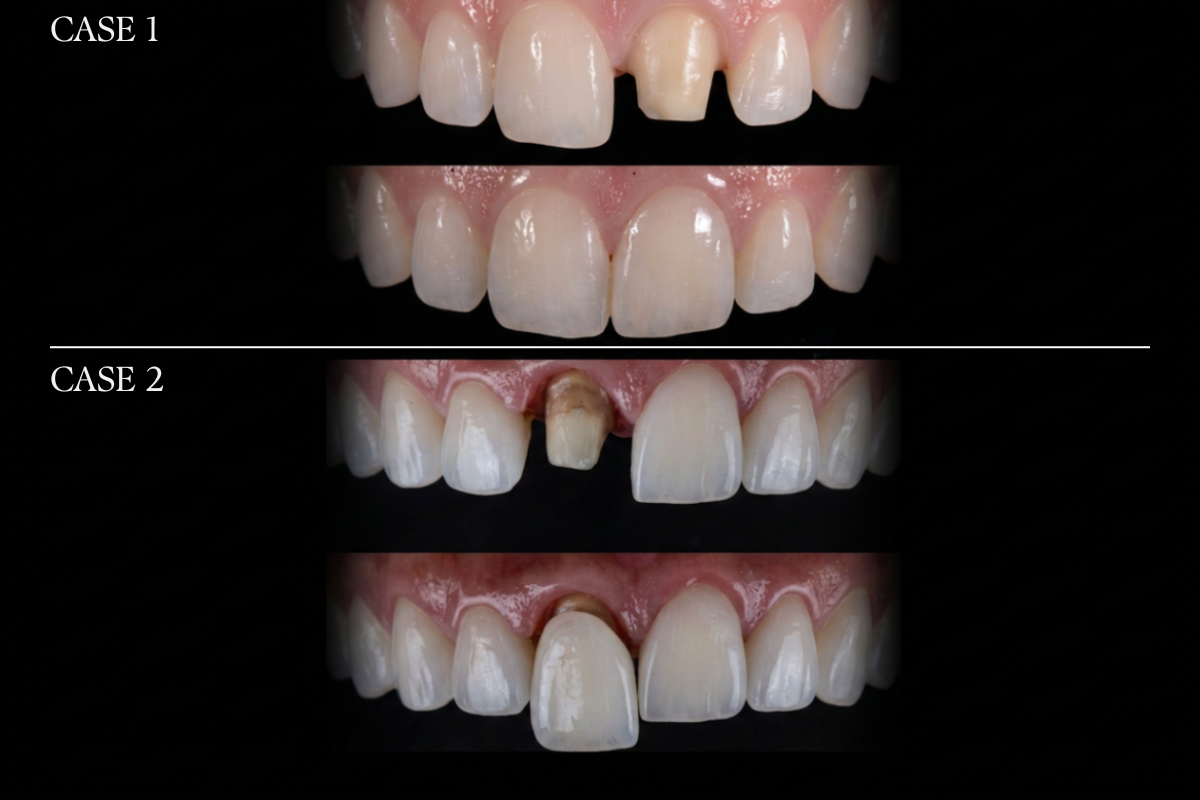
A dental crown is a custom-made cap that covers a damaged tooth completely, restoring its shape, strength and appearance. At Serene Smile Dental in Puchong, PFM crowns start from RM1,200 per unit and Emax or Zirconia crowns from RM1,800 per unit. Most crowns are fitted across two visits, about two weeks apart.
Key takeaways
- A crown covers the whole tooth. A filling or an onlay only replaces the part that is missing.
- PFM crowns start from RM1,200 per unit; Emax and Zirconia crowns start from RM1,800 per unit.
- Two appointments, roughly two weeks apart, with a temporary crown in between.
- A well-made crown on a healthy root routinely lasts 10 to 15 years, and often longer.
- The tooth underneath still decays, so the margin where crown meets tooth is what needs protecting.
What a dental crown actually does
When a tooth loses too much of its own structure, filling the hole stops working. A large filling sits inside the remaining walls of the tooth and pushes them apart every time you bite. Sooner or later one of those walls fractures, usually below the gum, and what was a restorable tooth becomes an extraction.
A crown reverses that mechanic. Instead of wedging the tooth open from the inside, it wraps around the outside and holds everything together. That is the whole point of the treatment: not appearance, but load distribution. The cosmetic result is a consequence of doing the engineering properly.
Crowns are made outside the mouth by a dental laboratory, from an impression or a digital scan of the prepared tooth. That is why they fit far more precisely than anything that can be shaped by hand while you are lying in the chair.
When you need a crown, and when you do not
A crown is usually the right call when:
- More than about half the biting surface of the tooth is gone.
- The tooth has had root canal treatment, particularly a molar or premolar, which becomes brittle without a cusp-covering restoration.
- A cusp has already fractured off.
- A very large old filling is failing and there is not enough tooth left to hold a new one.
- A tooth is severely worn down by grinding.
A crown is not the right call when a filling or an onlay would do the job. Preparing a tooth for a crown means removing healthy enamel all the way around, and that is not reversible. Where enough sound tooth remains, a more conservative restoration is the better dentistry. If you are weighing those options, our guide to onlays, crowns and bridges sets out where each one fits.
How we approach it: we prepare crowns under magnification and with careful margin placement, because the join between crown and tooth is where failure starts. A crown with an open or overhanging margin traps plaque, and the tooth decays underneath a restoration that still looks perfect from the outside.
Crown materials: PFM, Emax and Zirconia
Three materials cover almost every case we see in Puchong. They differ in strength, in how much light passes through them, and in how much tooth has to be removed to make room for them.
| Material | Best for | Appearance | Strength |
|---|---|---|---|
| PFM (porcelain fused to metal) |
Back teeth, bridge units, budget-conscious cases | Good, though a fine dark line can show at the gum over time | Very high — a metal core under a porcelain layer |
| Emax (lithium disilicate) |
Front teeth and premolars where appearance matters most | Excellent — translucency close to natural enamel | High, best suited to single units rather than long spans |
| Zirconia | Molars, heavy bites, patients who grind | Very good, and modern layered zirconia is hard to distinguish | Highest of the three |
In practice the choice is usually straightforward: appearance-critical front tooth, Emax; heavily loaded molar, Zirconia; multi-unit bridge or a case where cost is the deciding factor, PFM.
How much does a dental crown cost in Puchong?
Crown pricing at Serene Smile Dental, Puchong
| Crown type | Price | Basis |
|---|---|---|
| PFM crown | From RM1,200 | per unit |
| Emax crown | From RM1,800 | per unit |
| Zirconia crown | From RM1,800 | per unit |
Two things commonly change the final figure. The first is whether the tooth needs a core build-up: if there is not enough structure left to grip the crown, we rebuild the foundation before preparing it. The second is whether the tooth is still vital. A tooth that is already infected needs root canal treatment before a crown goes anywhere near it, and that is a separate procedure with its own cost.
This is also why a quoted price over the phone is close to meaningless until someone has looked at the tooth and an X-ray. We would rather give you an accurate number after ten minutes of examination than an attractive one that changes on the day.
The crown procedure, step by step
Visit one: preparation and impression
The tooth is numbed with local anaesthesia. We remove decay and any failing old filling, then reduce the tooth by roughly one to two millimetres on each surface to create room for the crown. If the foundation is weak, we build it back up at this point.
We then take a digital scan or impression, record the shade against the neighbouring teeth, and fit a temporary crown. The temporary is not just cosmetic — it stops the prepared tooth from becoming sensitive and keeps the neighbouring teeth from drifting into the space.
Between visits
The laboratory makes the crown, typically over one to two weeks. Chew on the other side, avoid anything sticky, and floss by pulling the floss out sideways rather than snapping it upwards, so you do not lift the temporary off.
Visit two: fitting and cementing
We remove the temporary and try the crown in without cement first, checking three things: the margin fit, the contact with the neighbouring teeth, and the bite. Only when all three are right does the crown get cemented. This appointment usually takes 30 to 45 minutes, and most patients need no anaesthesia for it.
How long crowns last, and what shortens their life
A well-fitted crown on a healthy root routinely lasts 10 to 15 years, and plenty last considerably longer. What ends a crown’s life is almost never the crown material itself. It is one of three things: decay starting at the margin, the root fracturing underneath, or gum disease loosening the whole tooth.
All three are largely preventable. Clean the gum line properly, floss around the crown daily, and keep your check-ups so the margin gets inspected. If you grind your teeth at night, a night guard protects the crown far more effectively than choosing a harder material.
Getting a crown in Puchong
If a tooth is cracked, heavily filled, or has recently had root canal treatment, the sensible next step is an examination and an X-ray so we can tell you honestly whether it needs a crown or whether something more conservative will do. Our clinic is in Puchong South, a short drive from Bandar Puteri, Bandar Kinrara and Puchong Jaya. You can read more about our clinic in Puchong or meet the dentists who would be treating you.
Not sure whether your tooth needs a crown?
Book an examination in Puchong and get a clear answer, with the cost confirmed before anything starts.
This article is for general information and does not replace an in-person dental examination. Treatment options and costs depend on your individual condition and can only be confirmed after a clinical assessment.
Frequently asked questions
How much does a dental crown cost in Puchong?
At Serene Smile Dental in Puchong, PFM crowns start from RM1,200 per unit and Emax or Zirconia crowns from RM1,800 per unit. Preparatory treatment such as root canal or a core build-up is quoted separately after examination.
How many appointments does a dental crown take?
Two. The first prepares the tooth, records the shade and fits a temporary crown. The second, usually one to two weeks later, fits and cements the final crown and takes about 30 to 45 minutes.
Is getting a crown painful?
The preparation appointment is done under local anaesthesia, so you should feel pressure but no pain. The fitting appointment usually needs no anaesthesia at all. Some sensitivity for a few days afterwards is normal.
Which crown material is best?
It depends on the tooth. Emax gives the most natural appearance and suits front teeth. Zirconia is the strongest and suits molars and patients who grind. PFM is a durable, more affordable option and works well for bridges and back teeth.
How long do dental crowns last?
A well-fitted crown on a healthy root routinely lasts 10 to 15 years and often longer. Lifespan depends far more on gum health, decay at the crown margin and grinding habits than on the crown material itself.
Can a crowned tooth still decay?
Yes. The crown itself cannot decay, but the natural tooth underneath can, particularly at the margin where the crown meets the tooth. Daily flossing around the crown and regular check-ups are what protect it.