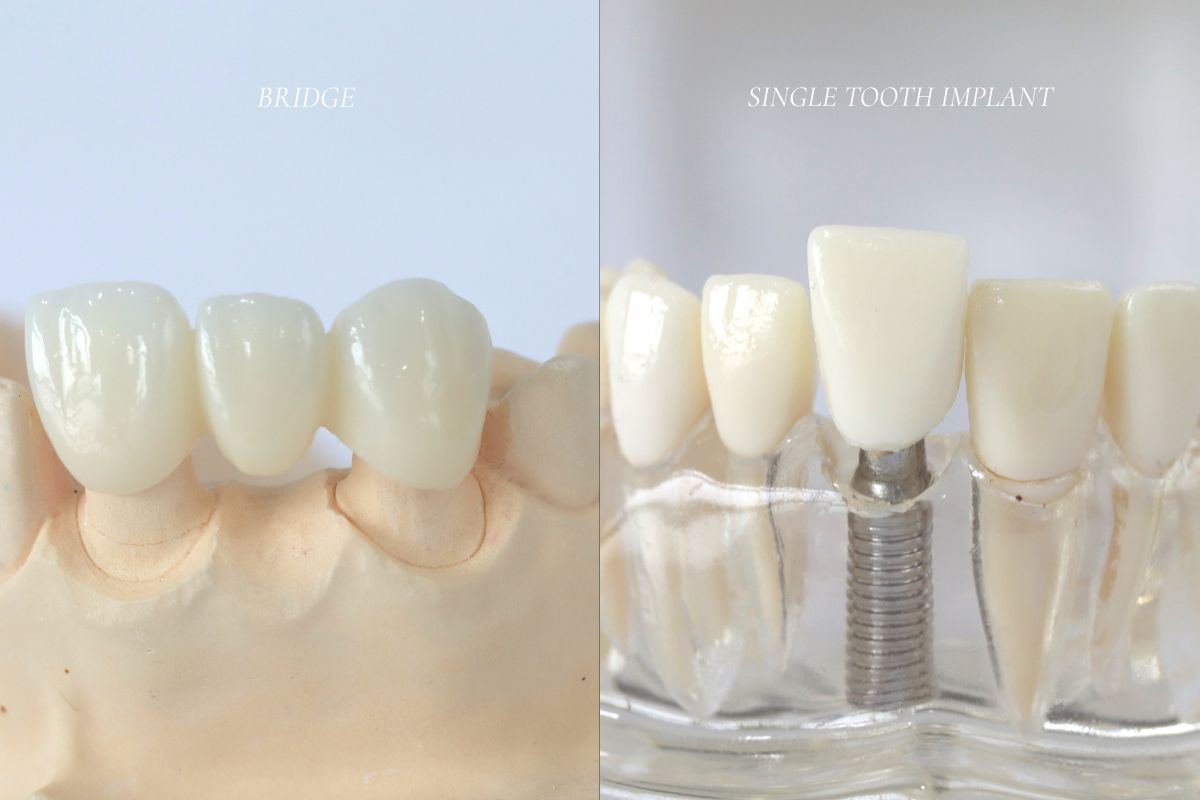
A bridge is faster and cheaper upfront but requires preparing the two neighbouring teeth. An implant costs more and takes months, but replaces only the missing tooth and preserves the bone. If the neighbouring teeth are healthy and untouched, an implant is usually the better long-term choice.
The difference that actually matters
Cost is what most people compare first, and it is the least useful comparison. The real difference is what each option does to the teeth around the gap.
A bridge borrows support from the two adjacent teeth. Both have to be reduced by one to two millimetres on every surface, permanently, to carry crowns. If those teeth are pristine, you are damaging two healthy teeth to replace a third.
An implant borrows nothing. A titanium post is placed in the jawbone where the root used to be, and a crown goes on top. The neighbouring teeth are never touched.
That single distinction decides most cases before cost enters the conversation.
| Bridge | Implant | |
|---|---|---|
| Neighbouring teeth | Both prepared and crowned | Untouched |
| Cost (single missing tooth) | From RM3,600 (3-unit PFM) | From RM6,000 |
| Time to complete | About 2 weeks | 3 to 6 months |
| Typical lifespan | 10 to 15 years | 15 to 25 years or more |
| Bone under the gap | Continues to shrink | Preserved by the implant |
| Surgery | None | Yes, minor |
| Cleaning | Floss threader needed under the pontic | Floss normally |
Cost compared honestly
At our Puchong clinic, a three-unit PFM bridge starts from RM3,600 and Emax or Zirconia from RM5,400. A single tooth implant starts from RM6,000 — the ranges are set out in our implant price guide and the bridge cost guide.
On day one the bridge is clearly cheaper. Over twenty-five years the arithmetic often reverses. A bridge lasting twelve years and then being remade — usually with additional work on a supporting tooth that has since decayed or needed root canal treatment — can end up costing more than a single implant that was never replaced.
That is not a guarantee, and we would not sell it as one. Bridges sometimes last decades and implants occasionally fail. But comparing only the upfront figure is comparing the wrong number.
The bone argument
This is the part most patients have never heard, and it is the strongest technical case for implants.
Jawbone maintains itself in response to load. A natural tooth transmits chewing force down its root into the bone, and the bone stays dense in response. Remove the tooth and that stimulus disappears. The bone in that area begins resorbing, fastest in the first year and continuing slowly thereafter.
A bridge sits above the gum. It restores chewing and appearance, but it transmits no force into the bone under the gap, so the ridge keeps shrinking. Over ten or fifteen years a visible dip develops under the false tooth, and a dark space opens between the pontic and the gum.
An implant is loaded like a root, so it preserves the bone around it. This also matters if you might want an implant later: the longer a gap goes without one, the more likely a bone graft becomes.
Time and process
Bridge: two appointments about two weeks apart. Prepare and take an impression, then fit and cement. Straightforward, no surgery, and you are finished within a fortnight.
Implant: the post is placed surgically, then needs three to six months to integrate with the bone before the crown goes on. A temporary can be provided in the meantime for a visible tooth. It is not a fast solution, and if you need something finished before a specific date, that is a legitimate reason to choose the bridge.
Which suits which situation
A bridge usually makes more sense when
- The neighbouring teeth already have large fillings or crowns, so preparing them costs you nothing extra.
- There is not enough bone for an implant and you would rather avoid a graft.
- A medical condition, uncontrolled diabetes or heavy smoking makes implant healing less predictable.
- You need the gap closed within weeks rather than months.
- The upfront cost is the deciding constraint.
An implant usually makes more sense when
- The neighbouring teeth are healthy and untouched.
- You are younger and the restoration needs to last decades rather than years.
- Several teeth are missing in different places, so a bridge would mean crowning a lot of sound teeth.
- Preserving the bone matters — for future options, or for appearance in a visible area.
- You would rather clean it like a normal tooth.
There is a third option people forget. A removable partial denture is far cheaper than either, and for some situations — several missing teeth, limited budget, or as a temporary measure while bone heals — it is a perfectly reasonable choice. Our comparison of implants versus dentures covers where it fits.
How the decision actually gets made
It needs an examination and an X-ray, usually a panoramic one. We are looking at the condition of the neighbouring teeth, how much bone height and width remains at the gap, where the nerve and sinus sit, your gum health, and your general medical picture.
Only then can either option be recommended honestly. A clinic that quotes you for one over the phone, without seeing the site, is guessing.
Replacing a missing tooth in Puchong
We are in Puchong South, near Bandar Puteri, Bandar Kinrara and Puchong Jaya. You can read more about our implant treatments or about crowns and how the supporting teeth of a bridge are prepared.
Bridge or implant?
Book an examination in Puchong and get both options costed and explained against your actual situation.
Frequently asked questions
Is a dental bridge or an implant better?
It depends on the neighbouring teeth. If they are healthy and untouched, an implant is usually the better long-term choice because it leaves them alone and preserves bone. If they already have large fillings or crowns, a bridge costs you little extra in tooth structure.
Which costs more, a bridge or an implant?
A three-unit PFM bridge starts from RM3,600 and a single tooth implant from RM6,000 in Puchong. The bridge is cheaper upfront, but over twenty-five years a bridge that needs remaking once can end up costing more.
How long does each take?
A bridge is completed in two appointments about two weeks apart. An implant takes three to six months, because the post needs time to integrate with the bone before the crown is placed.
Why does bone matter when replacing a tooth?
Jawbone maintains itself in response to chewing force. A bridge sits above the gum and transmits no force into the bone under the gap, so the ridge keeps shrinking. An implant is loaded like a root and preserves the bone around it.
Can I have an implant if I have been missing the tooth for years?
Often yes, but the longer a gap goes unfilled the more bone is lost, and a bone graft becomes more likely. An X-ray showing the remaining bone height and width is needed before this can be answered.
Is there a cheaper option than either?
A removable partial denture costs considerably less than both and can be a reasonable choice for several missing teeth, a limited budget, or as a temporary measure while bone heals after an extraction.

This article is for general information and does not replace an in-person dental examination. Treatment options and costs depend on your individual condition and can only be confirmed after a clinical assessment.