Dental bridges in Puchong are priced per unit, not per bridge. A PFM unit is from RM1,200 and an Emax or Zirconia unit from RM1,800, so a standard three-unit bridge replacing one missing tooth starts from RM3,600 in PFM or RM5,400 in Emax or Zirconia.
Key takeaways
- A bridge is priced by the number of units, and one missing tooth normally needs three units.
- PFM from RM1,200 per unit; Emax and Zirconia from RM1,800 per unit.
- The two teeth either side have to be prepared like crowns — that is the real cost of a bridge, and it is not financial.
- Preparatory work such as a root canal or gum treatment is quoted separately.
- A bridge is usually two appointments across about two weeks.
How bridge pricing actually works
The most common source of confusion is the word “unit”. A bridge is a single connected piece, but it is costed by counting the crowns it contains — one for each supporting tooth and one for each gap being filled.
Replace a single missing molar and you need a crown on the tooth in front, a false tooth in the gap, and a crown on the tooth behind. That is three units. Replace two adjacent missing teeth and you need four. The false tooth in the middle costs the same as a supporting crown, because it takes the same laboratory work to make.
Bridge pricing at Serene Smile Dental, Puchong
| Material | Per unit | Typical 3-unit bridge |
|---|---|---|
| PFM (porcelain fused to metal) | From RM1,200 | From RM3,600 |
| Emax | From RM1,800 | From RM5,400 |
| Zirconia | From RM1,800 | From RM5,400 |
What a bridge is, and what it costs you beyond money
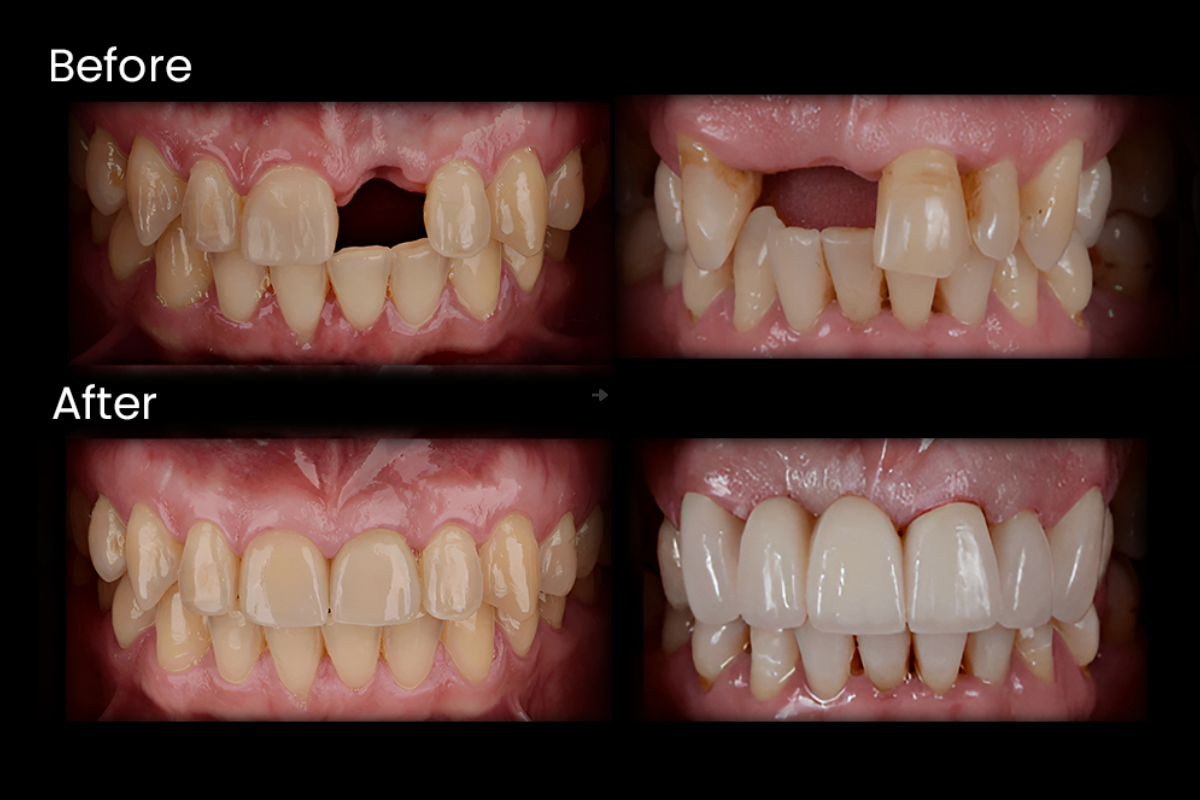
A bridge replaces a missing tooth by anchoring a false tooth to the teeth on either side. Those two teeth are prepared exactly as they would be for a crown — reduced by one to two millimetres on every surface to make room.
This is the part worth thinking about carefully. If the neighbouring teeth already have large fillings or crowns, using them as supports costs you nothing you have not already lost. If they are pristine, untouched teeth, you are permanently removing healthy enamel from two sound teeth to solve a problem with a third.
That does not make a bridge the wrong choice. It makes it a choice with a trade-off, and any dentist proposing one should put that trade-off in front of you rather than presenting the bridge as simply the cheaper option.
Types of bridge
Traditional bridge
Crowns on both sides with the false tooth suspended between. This is the standard design and covers the great majority of cases. Strong, predictable, and appropriate anywhere in the mouth.
Cantilever bridge
Supported on one side only. Occasionally useful where there is no suitable tooth on one side of the gap, but the single support takes considerably more leverage and it is not a first choice for back teeth.
Maryland (resin-bonded) bridge
A false tooth with thin metal or ceramic wings bonded to the back of the adjacent teeth. Its great advantage is that almost no tooth structure is removed. Its limitation is strength — it is best suited to front teeth in a light bite, and debonding is not unusual over the years.
Choosing the material
PFM is the workhorse for bridges. The metal substructure gives excellent rigidity across a span, which matters more on a bridge than on a single crown. A fine dark line can become visible at the gum margin over the years as gums recede.
Zirconia is the strongest ceramic option and handles heavy bites well, with no metal margin to show. Emax gives the most natural translucency and is best suited to shorter front-tooth spans rather than long posterior bridges.
For a back bridge under heavy load, PFM or Zirconia. For a visible front bridge, Emax or Zirconia. Our page on onlays, crowns and bridges sets out the options in more detail.
What else can change the total
- The supporting teeth need work first. If one is decayed, cracked, or already needs root canal treatment, that comes before the bridge and is costed separately.
- A core build-up is needed. A supporting tooth with insufficient structure has to be rebuilt before it can be prepared.
- Gum treatment. Bridges are not placed onto teeth with active gum disease. The margins sit at the gum line, and inflamed tissue will not give a stable result.
- Span length. Longer spans flex more and may need a stronger material or a different design.
This is why a figure quoted over the phone is only ever a starting point. We confirm the full cost after an examination and X-ray, before anything begins.
What happens if you leave the gap instead
Doing nothing is a legitimate option to consider, and for a missing wisdom tooth or a back molar with a healthy tooth still behind it, it is sometimes the right one. But it is worth knowing what a gap does over time, because the changes are slow enough to go unnoticed until they are difficult to reverse.
- The neighbouring teeth tilt into the space. Once a tooth tilts, it no longer meets the tooth above it correctly, and the tilted position creates a plaque trap on the leaning side.
- The opposing tooth over-erupts. With nothing to bite against, the tooth in the other jaw drifts down or up into the gap, sometimes far enough that it later needs reducing or removing before anything can be built in the space.
- The bone under the gap resorbs. Fastest in the first year and continuing slowly after. This is what makes an implant harder and more expensive the longer you wait.
- Chewing shifts to the other side, which loads that side more heavily over years.
The practical consequence is that a gap left for five years often costs more to restore than the same gap treated immediately, because the drifting and over-eruption have to be dealt with first.
How the treatment runs
Visit one: the supporting teeth are numbed and prepared, an impression or digital scan is taken, the shade is matched, and a temporary bridge is fitted. Visit two, about two weeks later: the bridge is tried in without cement to check fit, contacts and bite, then cemented. Most people find the second appointment straightforward and it rarely needs anaesthesia.
How long a bridge lasts
Ten to fifteen years is a reasonable expectation, and many last longer. What ends a bridge’s life is almost always one of the supporting teeth rather than the bridge itself — decay starting at a crown margin, or the root of a support fracturing.
Cleaning underneath the false tooth is the single most useful habit. Ordinary floss cannot pass through a bridge, so you need a floss threader or an interdental brush to clean the space beneath the pontic daily. Skip it and the supports will fail early.
Worth asking about: a bridge is not the only way to replace a missing tooth, and it is not automatically the cheapest over a lifetime. An implant costs more upfront but leaves the neighbouring teeth untouched. We will lay out both against your specific situation rather than defaulting to one.
Getting a bridge in Puchong
If you have lost a tooth and the neighbouring teeth are sound, it is worth having the options compared properly before committing. Our clinic is in Puchong South, close to Bandar Puteri, Bandar Kinrara and Puchong Jaya. You can also read our guide to dental crowns in Puchong, since the supporting teeth of a bridge are prepared in exactly the same way.
Replacing a missing tooth?
Book an examination in Puchong and get the bridge and implant options costed side by side.
Frequently asked questions
How much does a dental bridge cost in Puchong?
Bridges are priced per unit. A PFM unit is from RM1,200 and an Emax or Zirconia unit from RM1,800, so a three-unit bridge replacing one missing tooth starts from RM3,600 in PFM or RM5,400 in Emax or Zirconia.
Why is a bridge priced per unit?
A bridge contains a crown for each supporting tooth plus a false tooth for each gap. Each of those is a unit and each takes the same laboratory work, so replacing one missing tooth normally means three units rather than one.
How many appointments does a bridge take?
Two, usually about two weeks apart. The first prepares the supporting teeth, records the shade and fits a temporary bridge. The second checks the fit and bite, then cements the final bridge.
How long does a dental bridge last?
Ten to fifteen years is a reasonable expectation and many last longer. What usually ends a bridge’s life is one of the supporting teeth failing, most often from decay starting at a crown margin, rather than the bridge itself.
How do you clean under a dental bridge?
Ordinary floss cannot pass through a bridge. You need a floss threader, superfloss or an interdental brush to clean beneath the false tooth daily. This is the single most important habit for making a bridge last.
Is a bridge or an implant better?
A bridge costs less upfront but requires preparing the two neighbouring teeth. An implant costs more but leaves them untouched. If the neighbouring teeth already have large fillings or crowns, a bridge costs you little extra in tooth structure.

This article is for general information and does not replace an in-person dental examination. Treatment options and costs depend on your individual condition and can only be confirmed after a clinical assessment.