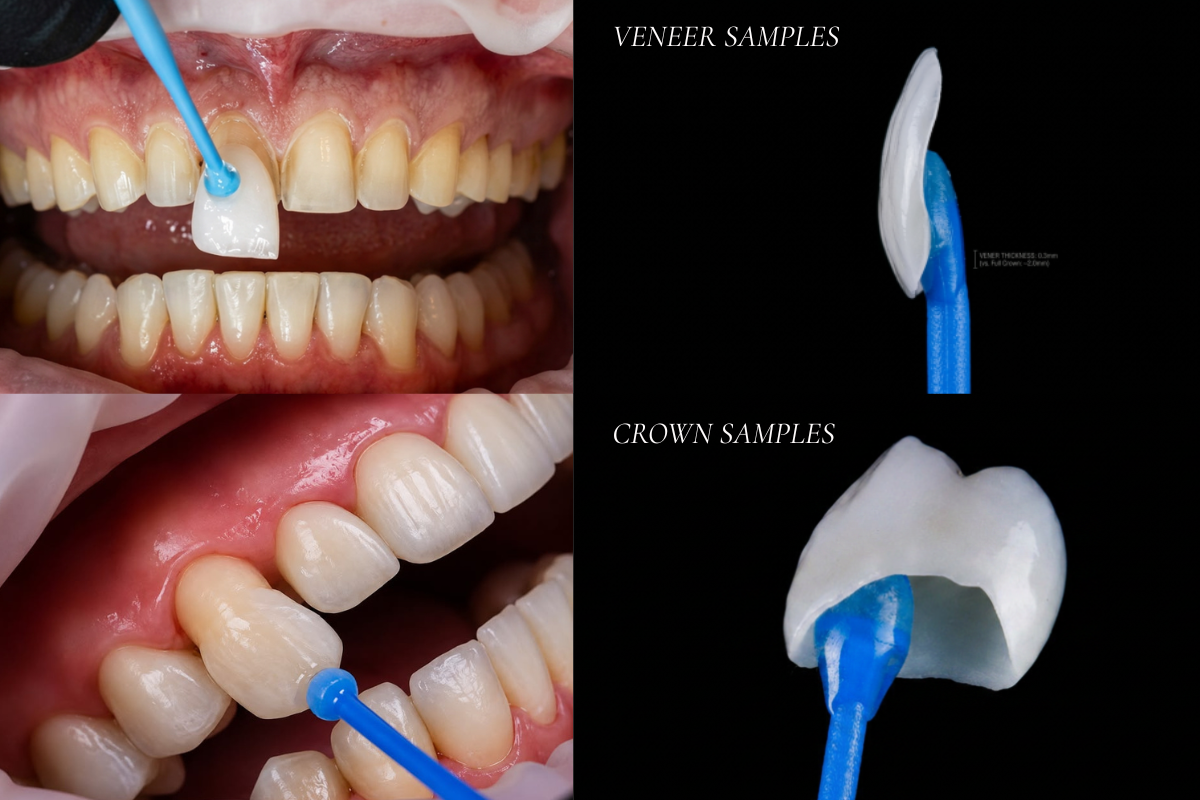
A crown covers the whole tooth and restores strength; a veneer covers only the front surface and changes appearance. If the tooth is damaged or weakened, you need a crown. If the tooth is sound but the wrong shape or colour, a veneer is usually enough.
The decision in one sentence
Crowns are a structural treatment. Veneers are a cosmetic one. Almost every case sorts itself out on that distinction alone, and where patients get confused is usually because they were offered whichever the clinic preferred rather than whichever the tooth required.
| Crown | Veneer | |
|---|---|---|
| Covers | The entire tooth, all surfaces | The front surface and biting edge only |
| Tooth removed | 1–2 mm from every surface | 0.3–0.7 mm from the front only |
| Main purpose | Restore strength to a damaged tooth | Change shape, colour or alignment |
| Suits | Cracked, heavily filled or root-treated teeth | Sound front teeth with a cosmetic issue |
| Where | Anywhere in the mouth | Front teeth almost exclusively |
How much tooth each one costs you
This is the difference that matters most, because it is permanent.
Preparing a tooth for a crown means reducing it by roughly one to two millimetres on every surface — front, back, sides and biting edge. On a tooth that is already broken down, that is fine: most of what is being removed is filling material or damaged structure anyway.
On a healthy tooth, it is a significant sacrifice. A veneer removes a fraction of that, typically 0.3 to 0.7 millimetres from the front surface, often staying entirely within the enamel. Bonding to enamel is also stronger and more predictable than bonding to dentine, which is part of why conservative veneer preparations perform so well.
The rule we work to: never remove more tooth than the problem requires. If a veneer solves it, a crown is over-treatment.
When a veneer is the right answer
- Discolouration that whitening cannot fix — intrinsic staining, tetracycline banding, or a single dark tooth after old trauma.
- Chipped or worn front edges, where the body of the tooth is sound.
- Small gaps between front teeth that you would rather not close with braces.
- Mildly rotated or uneven teeth, where the misalignment is small enough to mask.
- Teeth that are the wrong shape — narrow lateral incisors, for instance.
The common thread is that the tooth is structurally fine. You are changing what it looks like, not what it can withstand. Our guide to dental veneers in Puchong covers the options in detail, and the composite versus porcelain comparison covers the material choice.
When you need a crown instead
- More than about half the tooth is gone. A veneer bonded to a shell of remaining tooth will take the shell with it when it fails.
- After root canal treatment on a back tooth. The tooth is brittle and needs cusp coverage.
- A cracked or fractured cusp. Only full coverage holds the tooth together.
- A large old filling that is failing with little sound structure left around it.
- Any back tooth. Molars and premolars take grinding forces that veneers are not designed for.
- Heavy grinding. A veneer on a bruxist front tooth has a hard life; a crown is more forgiving, and a night guard is essential either way.
The honest test: ask whether the tooth would survive comfortably for another twenty years if you did nothing at all. If the answer is yes and you simply dislike how it looks, you are in veneer territory. If the answer is no, a veneer is treating the symptom and leaving the problem.
The cost difference
At our Puchong clinic, crowns are from RM1,200 per unit in PFM and from RM1,800 in Emax or Zirconia. Veneers are priced per tooth and vary considerably between composite and porcelain — our veneer price comparison sets out the current ranges.
Cost should not be the deciding factor between the two, because they are not really alternatives for the same problem. Choosing a veneer because it costs less, on a tooth that needed a crown, tends to produce a fracture and a considerably larger bill within a few years.
The third option people forget: composite bonding
Before choosing between a crown and a veneer, it is worth asking whether either is necessary. For a chipped corner, a small gap, or a single discoloured spot, composite bonding often solves the problem in one appointment.
The dentist adds tooth-coloured composite directly to the tooth and shapes it in the mouth. Nothing is sent to a laboratory, and in many cases little or no tooth structure is removed at all — which makes it entirely reversible, unlike both crowns and veneers.
The trade-off is longevity and stain resistance. Composite bonding typically lasts five to eight years before it needs refreshing, and it picks up stain from coffee, tea and smoking faster than porcelain does. Porcelain veneers hold their colour far better and last longer.
For a young patient, a small defect, or someone who wants to see how a change looks before committing to it permanently, bonding is frequently the sensible first step. It is not a lesser treatment; it is a less irreversible one.
Can you have both?
Yes, and in smile makeovers it is common. A typical case might be veneers on six sound upper front teeth and a crown on the one that had root canal treatment years ago. The materials are matched so the crown is indistinguishable from the veneers beside it.
This is where planning matters. Shade, translucency and shape have to be decided across the whole set at once rather than tooth by tooth, and the crown is usually the constraining element because it has less freedom to be adjusted later.
What to ask before agreeing
- Why this treatment rather than the other one, for this tooth?
- How much tooth structure will be removed?
- Is there a more conservative option — bonding, whitening, or aligners — that would get me close enough?
- What happens when it eventually needs replacing?
That last question is the one people forget. Both crowns and veneers are replaceable, but each replacement removes a little more tooth. Starting conservatively leaves you more options in twenty years.
Deciding in Puchong
The right answer depends on the specific tooth, and that needs an examination and usually an X-ray. Read more about crowns at our Puchong clinic or our full range of veneer treatments.
Crown or veneer — not sure which you need?
Book an examination in Puchong and we will tell you which the tooth actually requires, and why.
Frequently asked questions
What is the difference between a crown and a veneer?
A crown covers the entire tooth on all surfaces and restores strength. A veneer covers only the front surface and biting edge, and changes appearance. Crowns are structural treatment; veneers are cosmetic.
Does a veneer remove less tooth than a crown?
Considerably less. A crown preparation removes one to two millimetres from every surface. A veneer typically removes 0.3 to 0.7 millimetres from the front only, often staying within the enamel.
Can I have a veneer instead of a crown to save money?
Not if the tooth needs a crown. A veneer bonded to a weakened tooth does not restore strength, and choosing one to save money on a tooth that needed full coverage usually leads to a fracture and a larger bill later.
Can you put veneers on back teeth?
Very rarely. Molars and premolars take heavy grinding forces that veneers are not designed to withstand. Back teeth needing restoration are treated with fillings, onlays or crowns.
Can crowns and veneers be combined?
Yes, and it is common in smile makeovers. Shade, translucency and shape have to be planned across the whole set at once so the crown is indistinguishable from the veneers beside it.
Which lasts longer, a crown or a veneer?
Both commonly last ten to fifteen years or more when well made and well maintained. Longevity depends far more on gum health, bite forces and grinding habits than on which of the two you have.

This article is for general information and does not replace an in-person dental examination. Treatment options and costs depend on your individual condition and can only be confirmed after a clinical assessment.