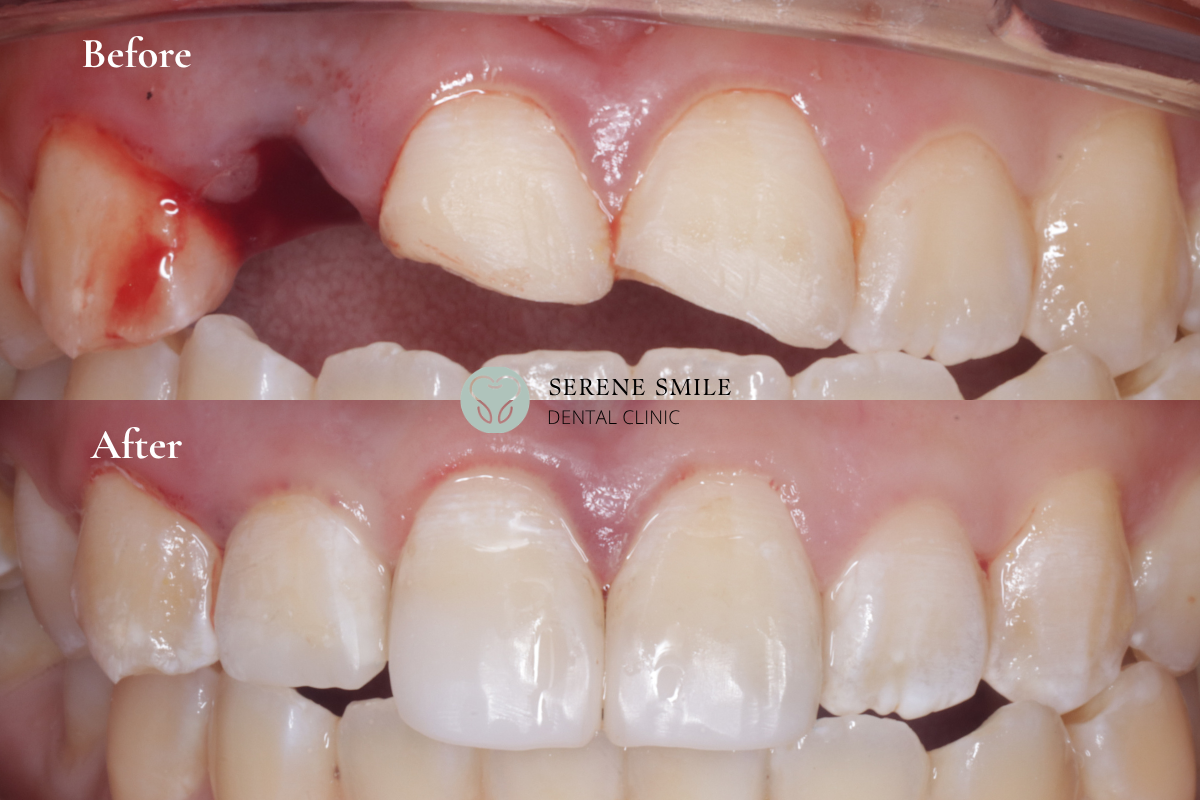
A knocked-out adult tooth can often be saved if it is put back within an hour. Handle it by the crown only, never the root, do not scrub it, and either reimplant it immediately or keep it in milk. Never reimplant a child’s baby tooth.
If a tooth has just been knocked out
- Find it. Pick it up by the crown — the part you normally see.
- Do not touch, scrub or wipe the root.
- If dirty, rinse for a few seconds in milk or saline. Not water if avoidable, never soap.
- Push it back into the socket if you can, and bite on a clean cloth.
- If you cannot, keep it in milk. Never in water and never dry.
- Get to a dentist within the hour.
Why the root must not be touched
This is the part that decides whether the tooth survives, and almost nobody knows it.
The root surface is covered by periodontal ligament cells — a living layer that attaches the tooth to the bone. If those cells survive, they reattach and the tooth can be retained for years. If they die, the body treats the root as foreign material and gradually resorbs it, and the tooth is lost even though it was successfully put back.
Those cells are killed by three things: drying out, mechanical scrubbing, and prolonged contact with plain water, which is not the right concentration for cells to survive in.
So handling the tooth by the crown is not squeamishness. It is the single most important thing you can do.
The first ten minutes, step by step
- Stay calm and find the tooth. Check clothing and the surrounding area.
- Pick it up by the crown. Never the pointed root end.
- Only rinse if visibly dirty, for a few seconds, ideally in milk or saline. Do not scrub, do not use soap, do not use antiseptic.
- Reimplant it if you can. Line it up the right way round, push it gently but firmly into the socket until it is level with the neighbouring teeth, and hold it there by biting on a clean cloth or gauze.
- If you cannot reimplant it, put it in milk immediately. Failing that, hold it inside your own cheek — saliva is better than nothing. Plain water is a last resort and only briefly.
- Get to a dentist within the hour. Call ahead so we are ready.
Reimplanting it yourself sounds daunting but it is genuinely the best thing for the tooth, because nothing preserves ligament cells as well as the socket they came from.
Time matters more than anything else
- Within 30 minutes: the best prospects. Ligament cells largely survive.
- 30 to 60 minutes, stored properly: still good.
- Over an hour, dry: prospects fall sharply. Bring it anyway — a tooth retained for even a few years is worth having, particularly in a teenager where it preserves bone during growth.
Milk is the recommended storage medium because its osmolarity and pH are close to what those cells need. Saline is comparable. Saliva works for short periods. Plain water is the worst option after leaving it dry.
Never reimplant a child’s baby tooth. Pushing it back can damage the developing adult tooth sitting in the bone directly above it. Control any bleeding with gentle pressure, keep the child calm, and bring them in to be checked. The gap will be managed appropriately, and a baby tooth lost early sometimes needs a space maintainer.
A broken or chipped tooth
The right response depends on how deep the fracture goes.
Small chip, enamel only
No pain, no sensitivity. Smooth the edge with sugar-free gum or dental wax so it does not cut your tongue, keep any fragment in milk, and book a routine appointment. Often repaired with composite bonding in one visit.
Larger fracture into dentine
Sensitive to air and cold, and the exposed surface may look yellowish. This needs seeing within a day or two: exposed dentine has open tubules leading to the nerve, and bacteria travel down them. Cover it and avoid temperature extremes meanwhile.
Fracture exposing the nerve
A pink or red spot in the middle of the broken surface, usually with immediate severe pain. This is urgent. Seen quickly, the nerve can sometimes be protected and the tooth kept vital; left, it needs root canal treatment.
Fracture below the gum, or a split root
Often extremely painful and sometimes not restorable. It still needs assessing promptly to decide between a crown, root treatment or extraction.
A tooth pushed out of position or loosened
Do not try to force it back. Leave it, avoid biting on it, eat soft food, and be seen the same day. Displaced teeth are repositioned and splinted to the neighbouring teeth so they can stabilise, and that works far better when done promptly.
What happens at the appointment
We check for other injuries first — jaw, other teeth, soft tissue. X-rays show root fractures, bone damage, and whether any fragment has been driven into the lip. A reimplanted tooth is splinted to its neighbours for one to two weeks, and root canal treatment is usually needed shortly afterwards, because the nerve does not survive the injury even when the tooth does.
Follow-up matters. Reimplanted teeth are monitored for root resorption over months and years. A tooth that has been broken or displaced is checked repeatedly, because nerves sometimes die quietly six months later.
Restoring a broken front tooth
Once the emergency is over, the options depend on how much tooth remains. Composite bonding handles small to moderate chips in one appointment. A veneer suits a larger fracture on a sound tooth. A crown is needed where much of the tooth is gone or it has had root canal treatment — our guide to dental crowns in Puchong covers that. Our cosmetic dentistry services cover the aesthetic side.
Emergency care in Puchong
Call or WhatsApp 011-6258 6880 and describe what happened — we can talk you through the first steps while you travel. More on what warrants which response in our guide to dental emergencies in Puchong.
Tooth knocked out or broken?
Call us now. With a knocked-out adult tooth, the first hour is what decides the outcome.
Frequently asked questions
What should I do if my tooth gets knocked out?
Pick it up by the crown, never the root. Rinse briefly in milk or saline only if dirty, without scrubbing. Push it gently back into the socket and bite on a clean cloth. If you cannot, keep it in milk and get to a dentist within the hour.
Why must I not touch the root of a knocked-out tooth?
The root is covered by living periodontal ligament cells that allow the tooth to reattach. Scrubbing, drying out or prolonged contact with plain water kills them, and without them the body resorbs the root even if the tooth is put back.
What should I store a knocked-out tooth in?
Milk is best, because its concentration and pH are close to what the ligament cells need. Saline is comparable and saliva works for short periods. Plain water is the worst option apart from letting it dry out.
How long do I have to save a knocked-out tooth?
Within 30 minutes gives the best prospects, and within an hour stored properly is still good. Beyond an hour dry, the outlook falls sharply, but it is still worth bringing in.
Should I put my child’s knocked-out baby tooth back in?
No. Reimplanting a baby tooth can damage the developing adult tooth in the bone above it. Control bleeding with gentle pressure and bring the child in to be checked.
What do I do about a broken tooth?
Rinse with warm water, keep any fragments in milk, and cover a sharp edge with sugar-free gum or dental wax. A chip with no pain can wait for a routine appointment; pain or a visible pink spot on the broken surface is urgent.
Will a reimplanted tooth need root canal treatment?
Usually yes, shortly after being splinted. The nerve does not generally survive the injury even when the tooth itself is successfully retained.

This article is for general information and does not replace an in-person dental examination. Treatment options and costs depend on your individual condition and can only be confirmed after a clinical assessment.