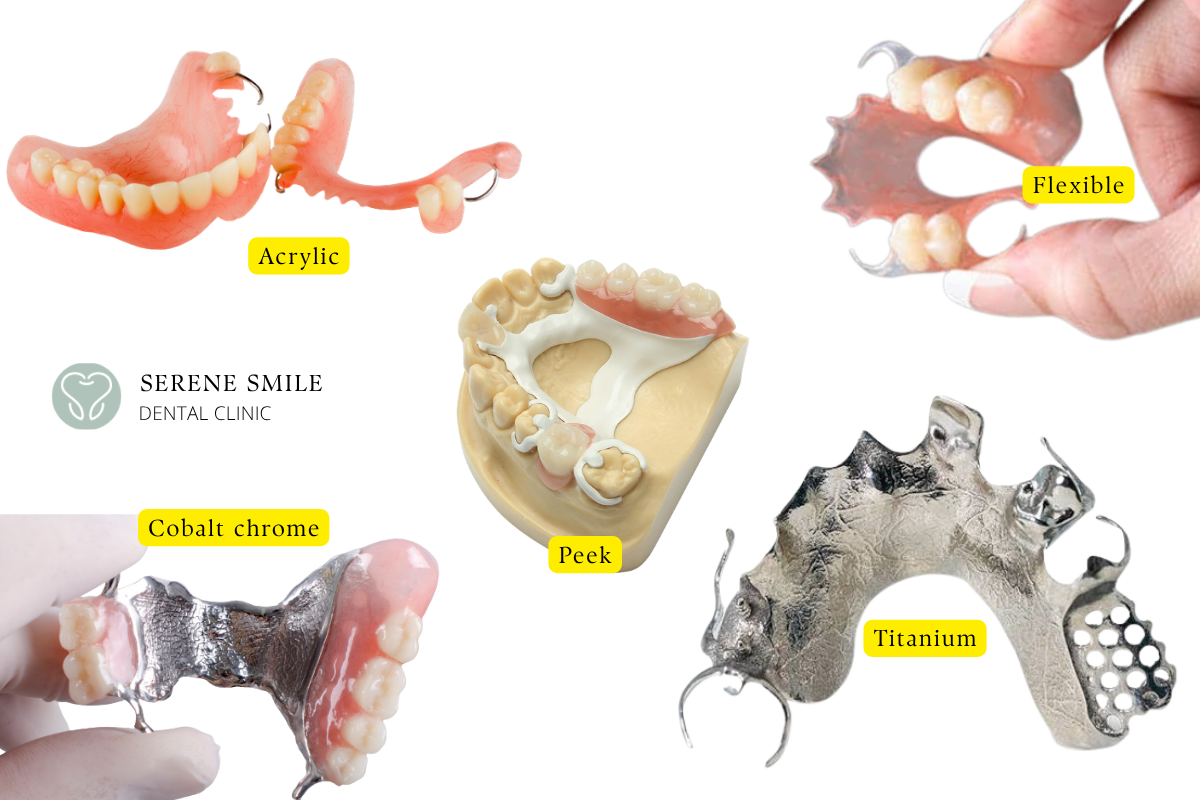
Five materials are realistically used for denture frameworks: normal acrylic, flexible acrylic, cobalt-chrome, PEEK and titanium. They differ in thickness, strength, whether clasps are visible, and how easily they can be adjusted or added to. The material is what drives the base cost, from RM350 up to around RM2,000.
Key takeaways
- The framework material sets the base cost; the number of teeth adds only RM50 each.
- Metal frameworks are thinner and stronger but their clasps can show.
- Flexible acrylic is the most discreet and the hardest to adjust or repair.
- Normal acrylic is the only one that can be easily added to if you lose more teeth.
- The best material depends on how many teeth remain and where, not on price alone.
How to think about the choice
Three questions decide it, in this order:
- How many teeth are you keeping, and where are they? A framework clasping four well-distributed teeth has a very different job to one resting mainly on gum.
- Will clasps be visible when you smile? If the gaps are at the front, this dominates everything else.
- Are you likely to lose more teeth? If yes, the ability to add to the denture later has real value.
Cost matters, but it should come fourth. A cheaper framework that has to be remade in two years is not cheaper.
| Material | Thickness | Visible clasps | Adjustable / repairable | Relative cost |
|---|---|---|---|---|
| Normal acrylic | Thickest | Wire clasps, can show | Easiest — adjust, repair, add teeth | Lowest |
| Flexible acrylic | Thin | None — gum-coloured | Difficult | Low–mid |
| Cobalt-chrome | Very thin | Metal clasps, can show | Repairable, hard to add to | Mid |
| PEEK | Thin | Tooth or gum coloured | Moderate | Mid–high |
| Titanium | Thinnest metal | Metal clasps | Repairable, hard to add to | Highest |
Normal acrylic
The conventional denture, and still the right answer more often than its reputation suggests.
Strengths. The most affordable by a clear margin. Easy to adjust chairside when a sore spot appears. Repairable if fractured. And critically, teeth can be added to it later — if you lose another tooth, the existing denture is modified rather than remade. It is also the natural choice for an immediate or transitional denture, where the appliance is expected to change as gums heal.
Limitations. It must be thick to be strong, so it feels bulkier and covers more palate. Metal wire clasps can be visible. It fractures more readily if dropped.
Best for: immediate and transitional dentures, situations where more teeth may be lost, and cases where budget is the deciding constraint.
Flexible acrylic
A thin, semi-flexible nylon-type material, gum-coloured throughout, with clasps that blend into the gum instead of showing as metal.
Strengths. By far the most discreet option. Thin and comfortable. Very difficult to fracture — it flexes rather than snapping. Excellent for a small partial replacing one or two front teeth where appearance is the priority.
Limitations. Adjustment and repair are genuinely difficult, and adding teeth later is usually not practical, so a new denture is required. It flexes under chewing load, which means it transmits force to the gum rather than distributing it to the remaining teeth — less ideal for larger cases. It can also stain over time and cannot be polished as readily.
Best for: small partials, particularly at the front, where visible clasps would be unacceptable.
Cobalt-chrome
A cast metal framework, and the traditional benchmark for a well-made partial denture.
Strengths. Extremely strong at a fraction of the thickness of acrylic, so it covers far less palate. This is the material that lets an upper partial leave the palate largely uncovered, which many patients find transformative for taste and comfort. It is rigid, so it distributes chewing forces to the remaining teeth rather than pressing into the gum. And it transmits temperature, so food actually tastes hot or cold.
Limitations. Metal clasps can be visible depending on where they sit. Adding teeth later is difficult, so significant further tooth loss usually means a new framework. Heavier than the polymer options, though most people stop noticing within days.
Best for: larger partial dentures with several remaining teeth to clasp, and anyone who dislikes palatal coverage.
PEEK
A high-performance polymer used increasingly in dentistry and orthopaedics.
Strengths. Metal-free, which matters for anyone with a nickel or cobalt sensitivity. Very light. Strong while remaining thin. Tooth or gum coloured, so clasps are discreet without the flexibility drawback of nylon. Biocompatible and well tolerated.
Limitations. More expensive than acrylic or cobalt-chrome. Slightly less rigid than cast metal, so for very large cases a metal framework may still distribute forces better. Fewer laboratories work with it routinely.
Best for: patients with metal sensitivities, and those wanting metal-free discretion with more rigidity than flexible acrylic offers.
Titanium
Strengths. The thinnest and lightest metal framework available, with excellent strength. Exceptionally biocompatible — allergic reaction is very rare, which is why it is used for implants. Corrosion resistant and durable.
Limitations. The most expensive option. Clasps are still metal and can be visible. Like cobalt-chrome, it is difficult to add to. It also demands more of the laboratory, since titanium is harder to cast and finish.
Best for: patients with metal sensitivities who still want a rigid metal framework, and anyone prioritising the thinnest, lightest possible appliance.
The question that is rarely asked and matters most: can teeth be added to this denture later? If you have several compromised teeth that may not survive five years, a normal acrylic denture that can be modified is often the better clinical decision than a superior framework that will need replacing entirely. The best material for the denture is not always the best material for the situation.
The teeth themselves are a separate choice
Everything above concerns the framework. The artificial teeth mounted on it are a distinct decision, and one that is rarely discussed.
- Acrylic teeth are standard. They bond chemically to an acrylic base, are easy to adjust and reshape chairside, and are gentle on any opposing natural teeth. They wear down faster, which over years can reduce the height of your bite.
- Composite teeth are more wear-resistant while remaining kind to opposing teeth.
- Porcelain teeth barely wear at all and hold their appearance indefinitely. The problem is that they are harder than natural enamel, so they wear down whatever they bite against — which is why they are generally avoided opposite natural teeth and reserved for full upper against full lower cases.
Shade and shape matter too, and both are decided at the try-in appointment. Perfectly uniform, very white teeth read as artificial. A slight irregularity and a shade matched to your age and complexion is what makes a denture unremarkable rather than obvious.
How material affects the price
At our Puchong clinic, denture pricing is a base cost plus RM50 per tooth replaced. The base is where the material shows up: from RM350 at the acrylic end, rising to around RM2,000 for the most advanced frameworks.
Because the per-tooth element is flat, the material choice dominates the total. A three-tooth partial in normal acrylic and the same three-tooth partial in titanium differ by well over a thousand ringgit, while adding five more teeth to either would add RM250. The arithmetic is set out in full in our denture cost guide.
Which to choose
- Budget is the constraint, or teeth may still be lost → normal acrylic.
- One or two front teeth, appearance is everything → flexible acrylic.
- Larger partial, several teeth to clasp, want the palate free → cobalt-chrome.
- Metal sensitivity, want discretion and rigidity → PEEK.
- Want the thinnest, lightest, most biocompatible metal → titanium.
None of these is a universal recommendation. Which applies depends on how many teeth remain and where they sit, which needs an examination. Our full guide to dentures in Puchong covers types and process.
Choosing in Puchong
We will show you the options, explain what each would mean for your specific case, and quote each so the comparison is concrete. We are in Puchong South, near Bandar Puteri, Bandar Kinrara and Puchong Jaya.
Not sure which denture material suits you?
Book an assessment in Puchong and see the options costed against your actual case.
Frequently asked questions
Which denture material is best?
It depends on how many teeth remain and where. Normal acrylic when budget matters or more teeth may be lost, flexible acrylic for small front partials, cobalt-chrome for larger partials, PEEK for metal sensitivities, titanium for the thinnest metal framework.
What is a flexible denture?
A thin, semi-flexible nylon-type appliance, gum-coloured throughout, with clasps that blend into the gum instead of showing as metal. It is the most discreet option but difficult to adjust, repair or add teeth to.
Why choose a metal denture framework?
Cobalt-chrome and titanium are extremely strong at a fraction of the thickness of acrylic, so they cover far less palate. They are rigid, so chewing forces are distributed to the remaining teeth, and they transmit temperature so food tastes hot or cold.
Can teeth be added to a denture later?
Easily with normal acrylic, which is why it is often the better choice if you have compromised teeth that may not survive. Metal frameworks and flexible acrylic are difficult or impractical to add to, usually requiring a new denture.
What is a PEEK denture?
A framework made from a high-performance polymer. It is metal-free, light, strong while remaining thin, and tooth or gum coloured, which makes it suitable for patients with nickel or cobalt sensitivities who want discretion with more rigidity than flexible acrylic.
How much does the material change the price?
Considerably. Denture pricing is a base cost plus RM50 per tooth, and the base ranges from RM350 for acrylic to around RM2,000 for the most advanced frameworks. The material dominates the total far more than the number of teeth.

This article is for general information and does not replace an in-person dental examination. Treatment options and costs depend on your individual condition and can only be confirmed after a clinical assessment.