
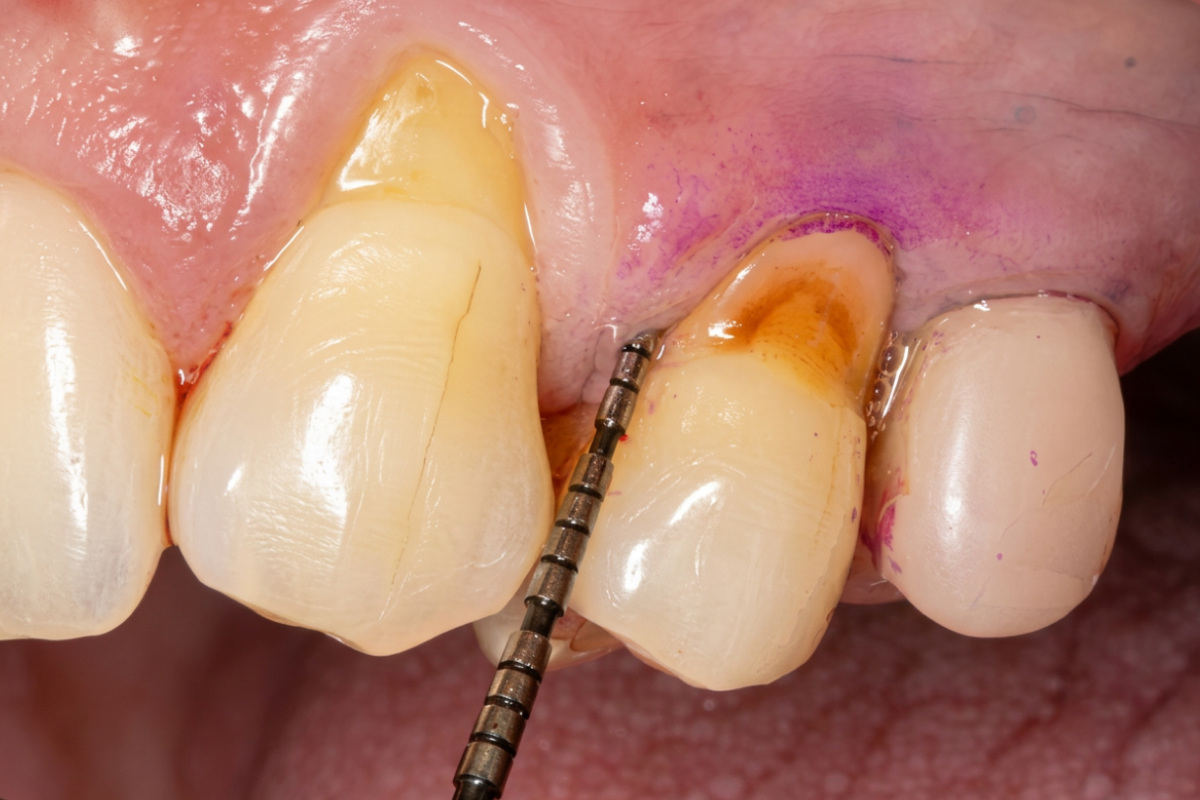
Gum disease progresses from reversible gingivitis to periodontitis, where the bone supporting the teeth is permanently lost. The early signs are bleeding when you brush, persistent bad breath and gums that look red or puffy. It is diagnosed by measuring the pocket depth at six points around every tooth.
Key takeaways
- Gingivitis is fully reversible. Periodontitis is not — the bone lost does not come back.
- The disease is almost entirely painless until teeth start to loosen, which is very late.
- A proper diagnosis means six measurements around every tooth, not a glance at the gums.
- Smoking masks the bleeding, which is why smokers often present with advanced disease.
- Treatment stops the progression and stabilises what remains. It does not rebuild what is gone.
Why gum disease is so easy to miss
Almost everything else that goes wrong with teeth eventually hurts. Gum disease does not, until it is far along. There is no ache, no sensitivity to cold, nothing that makes you book an appointment. The bone supporting your teeth can recede substantially while you feel completely fine.
What people do notice, they tend to dismiss. Bleeding when brushing gets attributed to brushing too hard. Bad breath gets treated with mouthwash. Gums looking a bit red is not the kind of thing that prompts a phone call. So the disease progresses quietly for years, and by the time a tooth feels loose, the supporting structure is largely gone.
This is precisely why it is diagnosed by measurement rather than by symptoms.
The signs worth acting on
- Bleeding when you brush or floss. The single most reliable early sign, and the most commonly ignored. Healthy gums do not bleed.
- Red, swollen or puffy gums instead of firm and pale pink.
- Persistent bad breath or a bad taste that does not clear with brushing.
- Gums pulling away from the teeth, so teeth look longer than they used to.
- Sensitivity at the gum line, as exposed root surface has no enamel over it.
- Food packing into new spaces between teeth.
- Teeth that feel loose, or that have drifted or splayed. This is a late sign.
- A change in how your teeth meet when you bite.
- Pus at the gum margin, or a recurring gum abscess.
How the disease progresses
It always starts the same way. Plaque accumulates at the gum line. If it is not removed within a day or two it hardens into calculus, which is rough, porous, and holds fresh plaque hard against the gum. The gum becomes inflamed in response. Left there, the inflammation deepens the crevice between gum and tooth, which creates space for more calculus deeper down, and the cycle turns.
| Stage | What is happening | Pocket depth | Reversible? |
|---|---|---|---|
| Healthy | Firm pink gums, no bleeding | 1–3 mm | — |
| Gingivitis | Inflammation of the gum only. No bone lost. | 1–3 mm, bleeding | Yes, fully |
| Early periodontitis | Attachment and some bone lost | 4–5 mm | No — but stoppable |
| Moderate periodontitis | Significant bone loss, possible recession | 5–7 mm | No — stoppable |
| Advanced periodontitis | Severe bone loss, mobility, possible tooth loss | 7 mm and above | No — harder to stabilise |
The critical threshold is 4 mm. Below it, the problem is inflammation of the gum and it can be reversed completely. Above it, attachment has been lost, and that is permanent. The whole purpose of catching gum disease early is to stay on the right side of that line. Everything before that threshold is treatable without consequence; everything after it is management rather than cure.
How we diagnose it: six measurements per tooth
This is where assessments differ most between clinics, and it is worth understanding what a thorough one looks like.
Gum disease is not uniform across the mouth. One tooth can have a healthy 2 mm crevice on its outer surface and a 6 mm pocket hidden between it and its neighbour. Looking at the gums, or spot-checking a few teeth, will not find that pocket. Nothing about it is visible.
So we chart six points around every single tooth — three on the outer surface, three on the inner — with a calibrated periodontal probe. For a full dentition that is over 150 individual measurements, recorded and kept.
That chart does three things a visual examination cannot:
- It finds the disease where it actually is. Pockets hide between teeth, which is exactly where a probe reaches and a mirror does not.
- It makes treatment site-specific. We treat the sites that need treating, at the depth they need, rather than applying the same cleaning everywhere.
- It gives a baseline. Re-charting after treatment shows objectively whether pockets have reduced. Without numbers, “your gums look better” is an impression, not a result.
We also record bleeding on probing at each site, and take X-rays to see the bone level directly, since the probe measures soft tissue and the X-ray shows what is underneath.
A fair question to ask anywhere: “Have my pocket depths been charted, and can I see the numbers?” If gum disease has been diagnosed without measurements, or treatment recommended on the basis of appearance alone, that is worth questioning. Numbers are what make the diagnosis specific and the result verifiable.
Treatment, by stage
Gingivitis
A thorough scale and polish to remove the calculus, plus genuinely specific home care advice — which surfaces you are missing, not general encouragement. Gums typically settle within one to two weeks and the condition resolves completely.
Early to moderate periodontitis
Root planing, sometimes called deep cleaning: a methodical cleaning of the root surface below the gum, usually done quadrant by quadrant under local anaesthesia. It is followed by re-charting after six to eight weeks to measure whether pockets have reduced. Our guide to gum treatment explains what is involved.
Advanced periodontitis
Deeper pockets that do not respond to root planing may need surgical access to clean the root properly, and in selected cases regenerative procedures. Teeth that are beyond stabilising are identified honestly rather than treated indefinitely.
Maintenance, permanently
This is the part that determines the long-term outcome and the part most often skipped. Once you have had periodontitis, three-monthly maintenance is the standard interval, not an upsell. The bacteria recolonise pockets in roughly that timeframe, and the disease recurs in people who stop.
What raises your risk
- Smoking — the single largest modifiable factor. It also constricts blood vessels, so gums bleed less and the disease advances unnoticed.
- Diabetes — the relationship runs both ways, and gum inflammation makes blood sugar harder to control.
- Genetics — some people are considerably more susceptible for the same amount of plaque.
- Stress, which affects immune response.
- Hormonal changes in pregnancy and menopause.
- Certain medications that cause dry mouth or gum overgrowth.
- Grinding, which does not cause gum disease but accelerates bone loss where it already exists.
Being honest about what treatment achieves
Treatment stops progression and stabilises the situation. It does not regrow lost bone, and it does not bring receded gums back up. Where recession has occurred, teeth will still look longer afterwards, and gaps that opened between teeth generally remain — in fact they often become more noticeable once swollen gum tissue shrinks back to healthy dimensions.
That is not a failure of treatment. Stopping a progressive disease and keeping your teeth is the result. But it is worth knowing beforehand rather than being surprised by it, and it is the strongest argument for acting at the gingivitis stage rather than later.
Getting your gums assessed in Puchong
If your gums bleed when you brush, or you have never had your pocket depths measured, a periodontal assessment gives you actual numbers rather than an impression. We are in Puchong South, near Bandar Puteri, Bandar Kinrara and Puchong Jaya.
Gums bleeding when you brush?
Book a periodontal assessment in Puchong. Six-point charting on every tooth, and you see the numbers.
Frequently asked questions
What are the first signs of gum disease?
Bleeding when you brush or floss is the most reliable early sign. Others are red, swollen or puffy gums, persistent bad breath, gums pulling away from the teeth, and sensitivity at the gum line.
Is gum disease reversible?
Gingivitis is fully reversible with proper cleaning and home care. Periodontitis is not, because the bone and attachment lost do not regrow. Treatment stops progression and stabilises what remains.
How is gum disease diagnosed?
By measuring the pocket depth at six points around every tooth with a calibrated probe, recording bleeding at each site, and taking X-rays to see the bone level. Pockets often hide between teeth where nothing is visible.
What pocket depth is normal?
One to three millimetres is healthy. Four millimetres and above indicates attachment loss, which is the point at which gingivitis has become periodontitis and the change becomes permanent.
Does gum disease hurt?
Usually not until it is advanced. This is why it is so often missed. Bone loss can be substantial before anything becomes uncomfortable, and by the time a tooth feels loose the supporting structure is largely gone.
Why do smokers get worse gum disease?
Smoking constricts the blood vessels in the gums, so they bleed less and the usual warning sign is masked. The disease advances unnoticed, which is why smokers often present with more advanced periodontitis.
How often do I need treatment once I have had gum disease?
Three-monthly maintenance is the standard interval after periodontitis. Bacteria recolonise pockets in roughly that timeframe, and the disease recurs in people who stop attending.

This article is for general information and does not replace an in-person dental examination. Treatment options and costs depend on your individual condition and can only be confirmed after a clinical assessment.