A filling replaces the part of a tooth destroyed by decay or fracture. At our Puchong clinic every filling is placed under rubber dam isolation with local anaesthesia, and the biting surface is carved back to the tooth’s original anatomy rather than left flat. Both decisions directly affect how long the filling lasts.
Key takeaways
- Composite bonds to the tooth chemically, and that bond fails if the tooth is contaminated by saliva during placement.
- Rubber dam is what keeps the field genuinely dry. It is the single biggest technical factor in how long a white filling lasts.
- Local anaesthesia is used routinely, not only for deep cavities — a tense patient cannot stay still long enough for careful work.
- The grooves and cusps of the biting surface are carved back deliberately. A flat filling changes how you chew and wears the opposing tooth.
- Once too much tooth is gone, a filling stops being the right answer and an onlay or crown takes over.
When a tooth needs a filling
The obvious case is decay. Bacteria produce acid, the acid dissolves mineral out of the enamel, and once the surface collapses the cavity spreads faster in the softer dentine underneath. That cavity does not remineralise on its own and it does not stop. It has to be cleaned out and the space rebuilt.
Fillings also treat fractured cusps, worn areas at the gum line, and — very often — the failure of an older filling. Old restorations develop gaps at their margins over the years, and decay restarts underneath a filling that still looks perfectly acceptable from above.
What is worth understanding is that most of this is painless while it is still simple. Decay only produces symptoms once it approaches the nerve, by which point the treatment is no longer a straightforward filling. That is the entire argument for regular examinations, and it is covered in more depth in our guide to protecting teeth from tooth decay.
Why we place every filling under rubber dam
This is the part of our approach that most patients have never encountered, so it is worth explaining properly.
Modern white fillings are not wedged into a hole the way amalgam was. Composite bonds to the tooth: an adhesive is applied to prepared enamel and dentine, and the resin locks into that adhesive layer. The strength of that bond is what holds the restoration in place and, just as importantly, what seals the margin against bacteria getting back underneath.
That bond is extraordinarily sensitive to moisture. A trace of saliva, blood, or even the humidity of your breath on the prepared surface at the wrong moment measurably weakens it. And a weakened bond does not fail dramatically on the day — it fails as a microscopic gap at the margin that lets decay restart two or three years later.
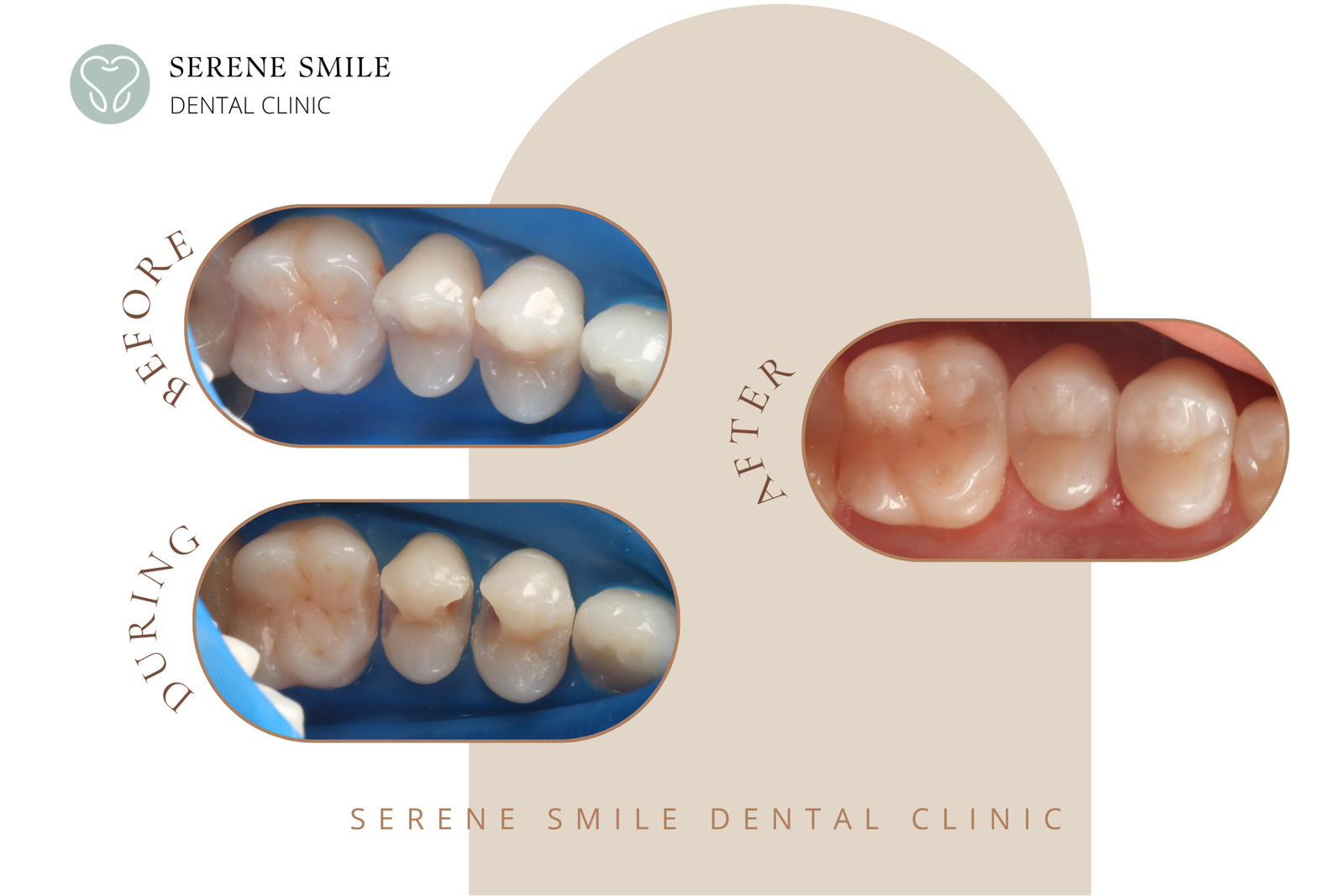
A rubber dam is a thin sheet that isolates the tooth being worked on from the rest of the mouth. It keeps saliva off the field completely, holds the tongue and cheek out of the way, and gives us clean, uninterrupted access. It is the difference between bonding to a dry surface and hoping the cotton roll held.
What patients usually say about it: almost everyone expects to dislike the rubber dam and almost nobody does. You can swallow normally, you are not tasting the materials, nothing is dropping to the back of your throat, and most people find the appointment considerably more comfortable than fillings they have had without it.
Local anaesthesia as standard, not as a last resort
We anaesthetise routinely for fillings, including shallow ones. There are two reasons, and only one of them is pain.
The first is straightforward: preparing a cavity involves removing decayed dentine close to the nerve, and dentine is sensitive well before it is painful. The second reason matters more for the result. Careful work requires the patient to stay still, and someone bracing for a twinge cannot stay still for twenty minutes. Numbing the tooth properly is what makes precise margin preparation and unhurried layering possible.
Carving the anatomy back: the biomimetic approach
A molar’s biting surface is not flat. It has cusps, ridges and grooves that developed to shear and grind food in a specific relationship with the tooth above it. When a filling is placed and simply smoothed over, that anatomy is lost.
The consequences are not cosmetic. A flat restoration changes how food is broken down, alters where force lands when you bite, and wears the opposing tooth unevenly because it no longer meets it the way it should. Over years, that shows up as a cracked cusp or a tooth that has migrated.
So we carve the morphology back — the cusp height, the groove pattern, the marginal ridges — to reproduce what was there before. We build composite in increments and shape each layer rather than filling the cavity in one mass, and we check the bite with the tooth under load rather than assuming it is right.
This is the biomimetic principle in practice: the goal is not merely to plug the hole, but to return the tooth to something that behaves like the original both mechanically and functionally.
Filling materials
Composite resin is what we use for essentially all direct fillings. It is tooth-coloured, bonds to the tooth, requires less healthy structure to be removed than amalgam did, and can be shaded to match the surrounding enamel. Shade selection is done before the tooth dries out, because teeth lighten noticeably once isolated.
Glass ionomer has a narrower role — some root-surface cavities, some children’s teeth, and situations where full moisture control genuinely is not achievable. It releases fluoride but is weaker and wears faster.
Amalgam is being phased out internationally and we do not place it.
How long a filling should last, and when it is the wrong answer
A well-placed composite filling in a well-isolated field commonly lasts eight to fifteen years. What ends its life is almost never the material wearing out — it is decay restarting at the margin, or the remaining tooth structure fracturing around it.
Which leads to the honest limitation. A filling relies on the surrounding walls of the tooth to support it. Once more than roughly half the biting surface is gone, or a cusp has already fractured, a large filling starts wedging the remaining walls apart every time you bite. At that point an onlay or a crown is the correct treatment, and we will tell you so rather than placing a filling we expect to fail.
What affects the cost of a filling
- How many surfaces are involved. A single-surface cavity and a three-surface rebuild are very different amounts of work.
- Which tooth. Front teeth need layered shading for appearance; molars need full anatomical carving and take the heaviest load.
- How deep the decay has gone. Deep cavities may need a protective liner over the nerve, and occasionally the nerve is already involved, which changes the treatment entirely.
- Whether it is a replacement. Removing an old failing restoration and assessing what is underneath adds time.
We confirm the fee after examining the tooth and taking an X-ray, before any treatment starts. Call the clinic if you would like the range in advance.
Getting a filling in Puchong
If a tooth is sensitive to sweet or cold, catches food, or has a rough edge you keep finding with your tongue, have it looked at while it is still a filling. You can read more about our general dentistry services or about what a check-up involves.
Think you need a filling?
Book an examination in Puchong. We will tell you honestly whether a filling is still the right treatment.
Frequently asked questions
Why do you use a rubber dam for fillings?
White fillings bond chemically to the tooth, and that bond is weakened by any contact with saliva, blood or breath moisture during placement. A rubber dam keeps the field completely dry, which is the single biggest technical factor in how long the filling lasts.
Is a rubber dam uncomfortable?
Most patients expect to dislike it and do not. You can swallow normally, you do not taste the materials, and nothing drops to the back of the throat. Many people find the appointment more comfortable than fillings placed without one.
Do fillings hurt?
The tooth is numbed with local anaesthesia first, so you should feel pressure and vibration but no pain. We anaesthetise routinely rather than only for deep cavities, because careful work requires you to be able to stay still and relaxed.
How long do white fillings last?
A well-placed composite filling in a properly isolated field commonly lasts eight to fifteen years. What usually ends its life is decay restarting at the margin or the surrounding tooth structure fracturing, not the material wearing out.
Why does the shape of a filling matter?
A molar’s biting surface has cusps and grooves that determine how food is broken down and where force lands when you bite. A flat filling changes that, wears the opposing tooth unevenly and can lead to a cracked cusp years later.
When is a filling not enough?
Once more than about half the biting surface is gone, or a cusp has already fractured, a large filling starts wedging the remaining walls apart when you bite. At that point an onlay or a crown is the correct treatment.

This article is for general information and does not replace an in-person dental examination. Treatment options and costs depend on your individual condition and can only be confirmed after a clinical assessment.