One thing decides between the three: how much sound tooth is left. A filling rebuilds a small cavity within intact walls. An onlay replaces a cusp or the whole biting surface while keeping the sides of the tooth. A crown covers everything and is used when too little structure remains to support anything less.
Think of it as a ladder, not a menu
These are not three competing products you choose between on preference. They are three rungs on a ladder of increasing coverage, and the correct rung is determined by the tooth, not by budget or by what you would prefer.
The governing principle is simple and worth stating plainly: remove no more tooth than the problem requires. Every step up the ladder costs healthy structure that never comes back, so the right treatment is the least invasive one that will actually hold.
| Filling | Onlay | Crown | |
|---|---|---|---|
| Covers | The cavity only | One or more cusps, or the whole biting surface | The entire tooth |
| Made | In the mouth, same visit | In a laboratory | In a laboratory |
| Visits | One | Two | Two |
| Tooth removed | Decay only | Decay plus the damaged surface | 1–2 mm from every surface |
| Right when | Walls of the tooth are intact | A cusp is lost or cracked, sides are sound | Little sound structure remains |
When a filling is enough
A filling is the right answer while the surrounding walls of the tooth are still strong enough to support it. It is placed directly, in one appointment, and bonded into the cavity.
Its limitation is mechanical rather than material. A large filling sits inside the remaining walls and pushes them outwards under load. Small filling, strong walls, no problem. Very large filling, thin walls, and it becomes a wedge that eventually splits a cusp off — usually below the gum line, which is what turns a restorable tooth into an extraction.
How well a filling performs also depends heavily on how it was placed. We do every filling under rubber dam isolation with the anatomy carved back, and the reasoning is set out in our guide to dental fillings in Puchong.
When an onlay is the right middle ground
An onlay is the option most patients have never been offered, and it is often the correct one.
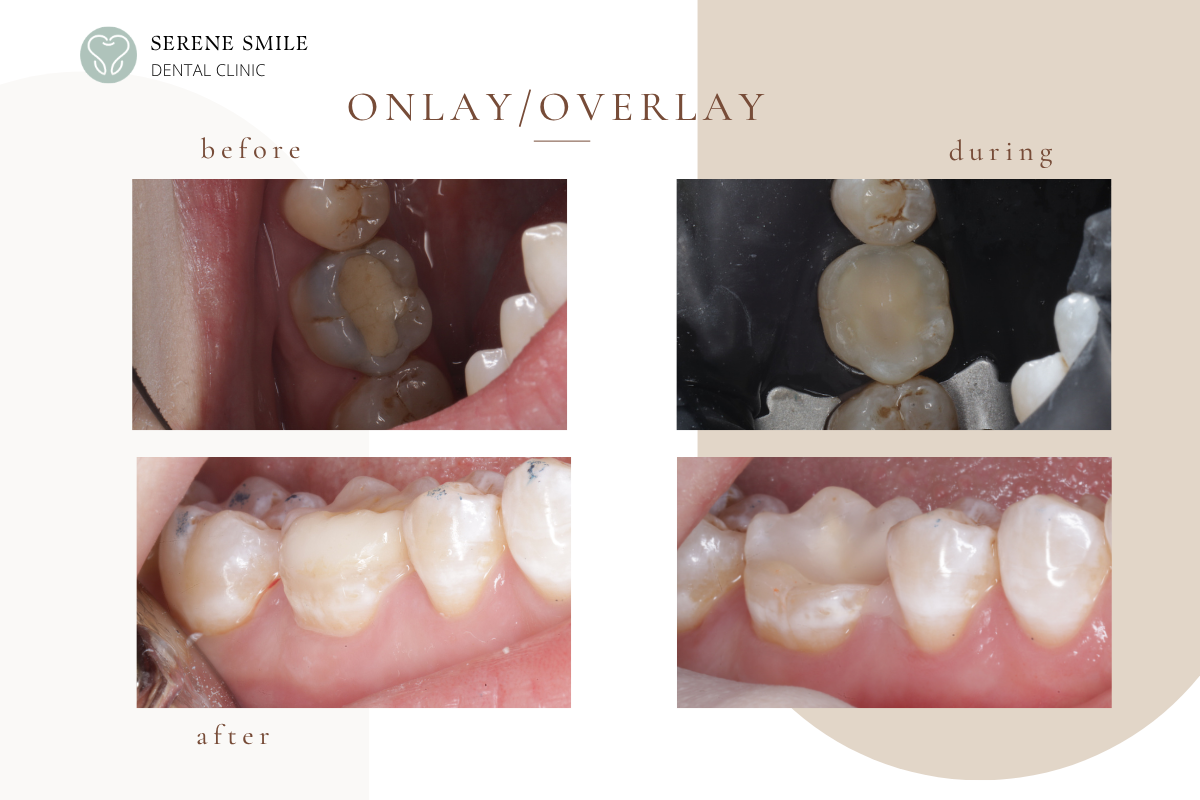
It is made in a laboratory, like a crown, but it replaces only the damaged part — typically the biting surface and one or more cusps — while leaving the sound outer walls of the tooth completely intact. Because it is fabricated outside the mouth, it has better strength and a more precise fit than a large direct filling, and because it is bonded in place, it holds the remaining tooth together rather than wedging it apart.
An onlay is usually the right call when:
- A cusp has fractured off but the rest of the tooth is solid.
- A very large old filling is failing, yet the outer walls are still sound.
- The tooth has a crack running across the biting surface that needs to be held together.
- A crown would work, but would mean sacrificing healthy tooth unnecessarily.
Why onlays are underused: they are more technically demanding than crowns. A crown preparation is forgiving — you reduce the whole tooth and the shape almost takes care of itself. An onlay requires precise, conservative preparation and reliable bonding, which means proper isolation. It is easier to crown a tooth than to onlay it, and that is not a good enough reason to remove more tooth than necessary.
When a crown is genuinely needed
A crown covers the tooth completely and is the right treatment when there is no longer enough sound structure to support anything less:
- More than roughly half the tooth is gone.
- Multiple cusps are cracked or missing.
- The tooth has had root canal treatment, particularly a molar or premolar, which becomes brittle without full cusp coverage.
- The outer walls are thin, undermined, or already fractured.
- A previous onlay or large filling has failed and there is less to work with now.
In these situations a crown is not over-treatment — it is the only restoration that will distribute load safely. Our guide to dental crowns in Puchong covers the materials and the procedure, and how long crowns last covers what determines their lifespan.
What it costs
Crowns at our Puchong clinic are from RM1,200 per unit in PFM and from RM1,800 in Emax or Zirconia. Fillings and onlays are quoted after examination, because the fee depends on how many surfaces are involved, how deep the decay has gone, and whether the tooth needs rebuilding before the restoration is placed.
An onlay generally sits between a large filling and a crown in cost. But choosing the cheaper option on a tooth that needed the more extensive one is usually a false economy — a filling that splits a cusp within two years turns into a crown anyway, plus the cost of the filling and possibly root canal treatment on top.
What to ask your dentist
- How much sound tooth is actually left?
- Would an onlay work here, or is there a specific reason it would not?
- How much tooth will be removed for the option you are recommending?
- What happens if I choose the more conservative option and it fails?
That last question is fair and the answer should be honest. Sometimes the conservative option is worth attempting even if it might not last, because failure still leaves the crown available. Sometimes it is not, because failure means losing the tooth. Which of those applies is exactly what an examination is for.
Getting assessed in Puchong
Deciding between the three needs an examination and usually an X-ray to see how much structure remains and whether there is a crack. We are in Puchong South, near Bandar Puteri, Bandar Kinrara and Puchong Jaya. Read more about our onlay, crown and bridge treatments.
Filling, onlay or crown?
Book an examination in Puchong and we will recommend the least invasive option that will actually last.
Frequently asked questions
What is the difference between an onlay and a crown?
An onlay replaces only the damaged part of the tooth, usually the biting surface and one or more cusps, while leaving the sound outer walls intact. A crown covers the entire tooth and requires removing one to two millimetres from every surface.
When do I need a crown instead of a filling?
When more than about half the tooth is gone, when multiple cusps are cracked or missing, after root canal treatment on a back tooth, or when the outer walls are thin and undermined. A large filling in those situations acts as a wedge and eventually splits a cusp.
Is an onlay better than a crown?
It is better when it is possible, because it preserves healthy tooth structure. It is not better when too little sound tooth remains to support it. The right choice depends on how much of the tooth is left, not on preference.
Why are onlays rarely offered?
They are more technically demanding. A crown preparation is forgiving because the whole tooth is reduced. An onlay requires precise conservative preparation and reliable bonding, which means proper moisture isolation.
How many appointments does an onlay take?
Two, like a crown. The first prepares the tooth and takes an impression or digital scan, with a temporary restoration fitted. The second checks the fit and bite, then bonds the onlay in place.
Can a filling be replaced with an onlay later?
Yes, and it is a common sequence. If a large filling fails but the outer walls of the tooth are still sound, an onlay is often the right next step rather than going straight to a crown.

This article is for general information and does not replace an in-person dental examination. Treatment options and costs depend on your individual condition and can only be confirmed after a clinical assessment.