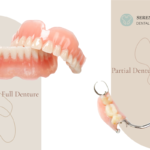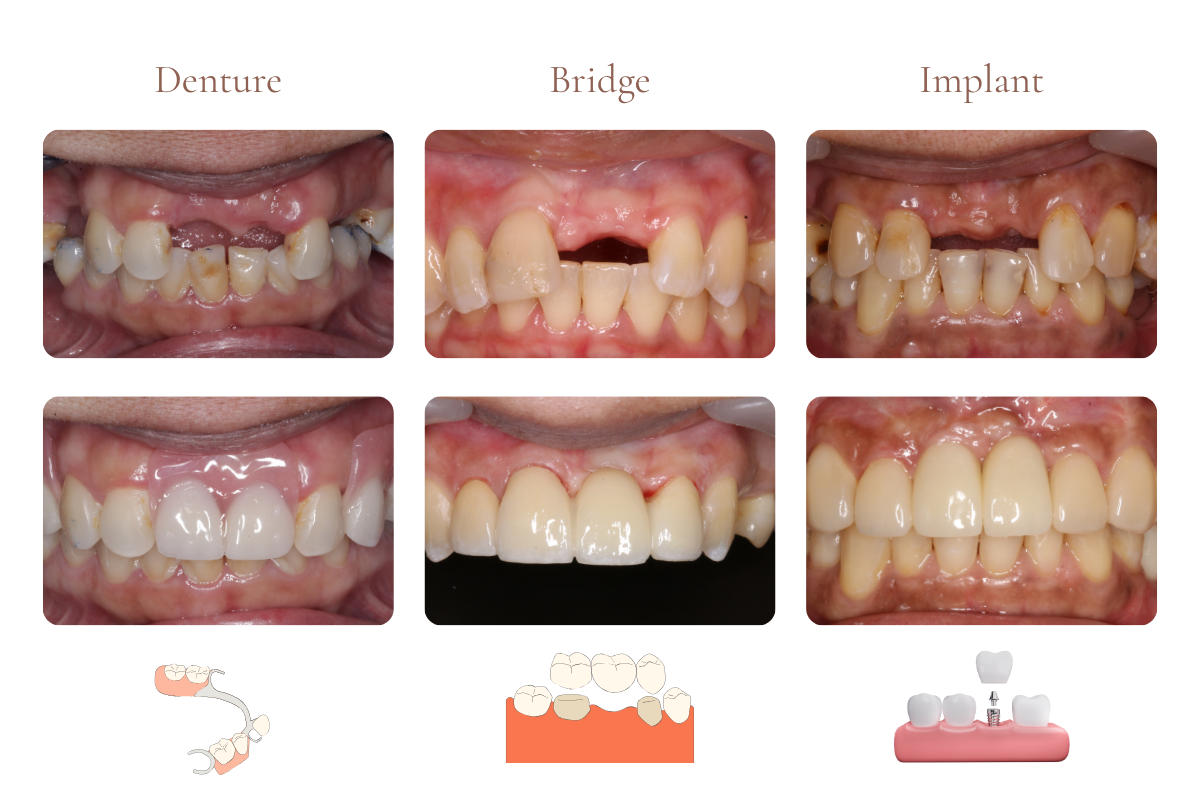
Dentures are the most affordable option and the only one that replaces many teeth at once. A bridge is fixed but requires crowning the neighbouring teeth. An implant is the most expensive and the only one that preserves the bone. Which is best depends on how many teeth are missing and where.
Start with the number, not the price
The comparison people usually make is cost, and it is the wrong starting point. The first question is how many teeth are missing and whether there are healthy teeth on both sides of each gap. That narrows the field before money enters it.
- One tooth missing, healthy teeth either side. Bridge or implant. A partial denture for a single tooth is possible but rarely the best answer.
- Several teeth missing in different places. A partial denture handles it in one appliance. Bridging each gap would mean crowning a great many sound teeth.
- Teeth missing at the very back with nothing behind. A bridge is not possible without an implant to anchor it. Denture or implant.
- A whole arch missing. Full denture, implant-retained overdenture, or a full-arch implant solution.
| Denture | Bridge | Implant | |
|---|---|---|---|
| Fixed or removable | Removable | Fixed | Fixed |
| Cost | From RM350 base + RM50/tooth | From RM3,600 (3-unit PFM) | From RM6,000 |
| Neighbouring teeth | Clasped, not cut | Both crowned | Untouched |
| Time to complete | Several weeks | About 2 weeks | 3 to 6 months |
| Typical lifespan | 5 to 10 years, with relines | 10 to 15 years | 15 to 25 years or more |
| Bone underneath | Continues to shrink | Continues to shrink | Preserved |
| Chewing efficiency | Roughly 20–40% of natural | Close to natural | Close to natural |
| Multiple gaps at once | Yes, one appliance | No, one per gap | Yes, but cost multiplies |
Dentures
The strength of a denture is coverage. One appliance can replace two teeth or fourteen, in any arrangement, for a fraction of what fixed options cost. Nothing is drilled, nothing is surgical, and it can be added to if you lose more teeth later.
The weakness is that it sits on the gum rather than in the jaw. Chewing efficiency is markedly lower than natural teeth — enough that hard and chewy foods become difficult. It moves, particularly the lower one. It has to be removed and cleaned. And because it transmits no force into the bone, the ridge underneath keeps resorbing, which is why dentures need relining every few years and remaking eventually.
Our guide to dentures in Puchong covers the types and how pricing works.
Bridges
A bridge is fixed, feels close to natural, and is finished in about two weeks. For a single gap between two teeth that already have large fillings or crowns, it is frequently the most sensible option — you are using teeth that have already lost structure rather than sacrificing healthy ones.
The cost is not only financial. Both neighbouring teeth are reduced by one to two millimetres on every surface, permanently. If they are pristine, that is a real sacrifice to solve a problem with a third tooth. A bridge also transmits no force into the bone under the gap, so the ridge there continues to shrink and a visible dip develops over ten or fifteen years. Our bridge cost guide covers how per-unit pricing works.
Implants
An implant replaces the root as well as the crown. It touches nothing else, it is loaded like a natural tooth so the bone around it is maintained, it is cleaned like a normal tooth, and it lasts longer than either alternative.
It costs the most, it takes three to six months because the post has to integrate with bone before the crown goes on, and it involves minor surgery. It also requires enough bone to place into, which is not guaranteed if teeth have been missing for years. Our implant price guide and the comparison of implants versus dentures go further.
The option that gets overlooked: an implant-retained overdenture. Two implants in the lower jaw, with a denture that clips onto them. It costs far less than a full arch of individual implants and solves the single biggest complaint about lower dentures — that they move. If a lower denture is what you are dreading, this is worth asking about specifically.
Cost over time, not on the day
Comparing the upfront figures makes dentures look decisively cheaper, and over five years they are. Over twenty-five, the picture is less clear.
A denture typically needs relining every few years as the ridge resorbs, and remaking roughly every five to ten. Across two decades that is several appliances. A bridge lasting twelve years and then being remade — usually with additional work on a supporting tooth that has since decayed — can approach the cost of an implant that was never replaced.
None of this makes dentures a false economy. For multiple missing teeth they remain far cheaper by any measure. But for a single tooth, the upfront comparison overstates the difference.
When each is genuinely the right answer
Denture
Several teeth missing across different parts of the mouth; no teeth left in an arch; insufficient bone for implants and no wish to graft; budget is the deciding constraint; or as a temporary solution while bone heals after extractions.
Bridge
One or two adjacent teeth missing with sound teeth either side; those neighbouring teeth already crowned or heavily filled; a medical reason implant healing would be unpredictable; or the gap needs closing within weeks.
Implant
Neighbouring teeth are healthy and untouched; you are younger and want something lasting decades; a back tooth with nothing behind it to bridge from; preserving bone matters; or you want to clean it like a normal tooth.
What the decision actually needs
An examination and an X-ray, usually panoramic. We look at how many teeth are missing and where, the condition of what remains, bone height and width at each site, gum health, and your medical history. Only then can any of the three be recommended honestly.
Combinations are common and often best — an implant where it matters most, a partial denture covering the rest. It is rarely a single choice for the whole mouth.
Deciding in Puchong
We are in Puchong South, near Bandar Puteri, Bandar Kinrara and Puchong Jaya. You can read more about our implant treatments.
Not sure which option fits?
Book an assessment in Puchong and get all three costed against your actual situation.
Frequently asked questions
Which is best: dentures, a bridge or an implant?
It depends on how many teeth are missing and where. A partial denture handles several gaps in one appliance. A bridge suits a single gap with sound teeth either side. An implant is best when the neighbouring teeth are healthy and you want the longest-lasting result.
How much does each option cost in Puchong?
Dentures start from a RM350 base plus RM50 per missing tooth. A three-unit PFM bridge starts from RM3,600. A single tooth implant starts from RM6,000.
Can I chew normally with dentures?
Chewing efficiency with a full denture is roughly 20 to 40 per cent of natural teeth, so hard and chewy foods become difficult. Bridges and implants are close to natural.
What is an implant-retained overdenture?
A denture that clips onto two or more implants rather than resting on gum alone. It costs far less than a full arch of individual implants and solves the main complaint about lower dentures, which is that they move.
Do dentures cause bone loss?
A denture rests on the gum and transmits no force into the jaw, so the ridge underneath continues to resorb. Bridges have the same limitation under the gap. Only an implant is loaded like a root and preserves bone.
Can I combine options?
Yes, and it is often the best answer. An implant where it matters most with a partial denture covering the rest is common. It is rarely a single choice for the whole mouth.

This article is for general information and does not replace an in-person dental examination. Treatment options and costs depend on your individual condition and can only be confirmed after a clinical assessment.