Dry socket is severe pain that begins three to five days after an extraction, when the blood clot in the socket is lost before the site has healed. It is not an infection. Treatment is quick and effective: the socket is cleaned and a medicated dressing placed, which relieves the pain within hours.
What dry socket is
After a tooth comes out, a blood clot forms in the socket. That clot is not just plugging a hole — it is the scaffold the gum and bone heal across, and it covers exposed bone and nerve endings while that happens.
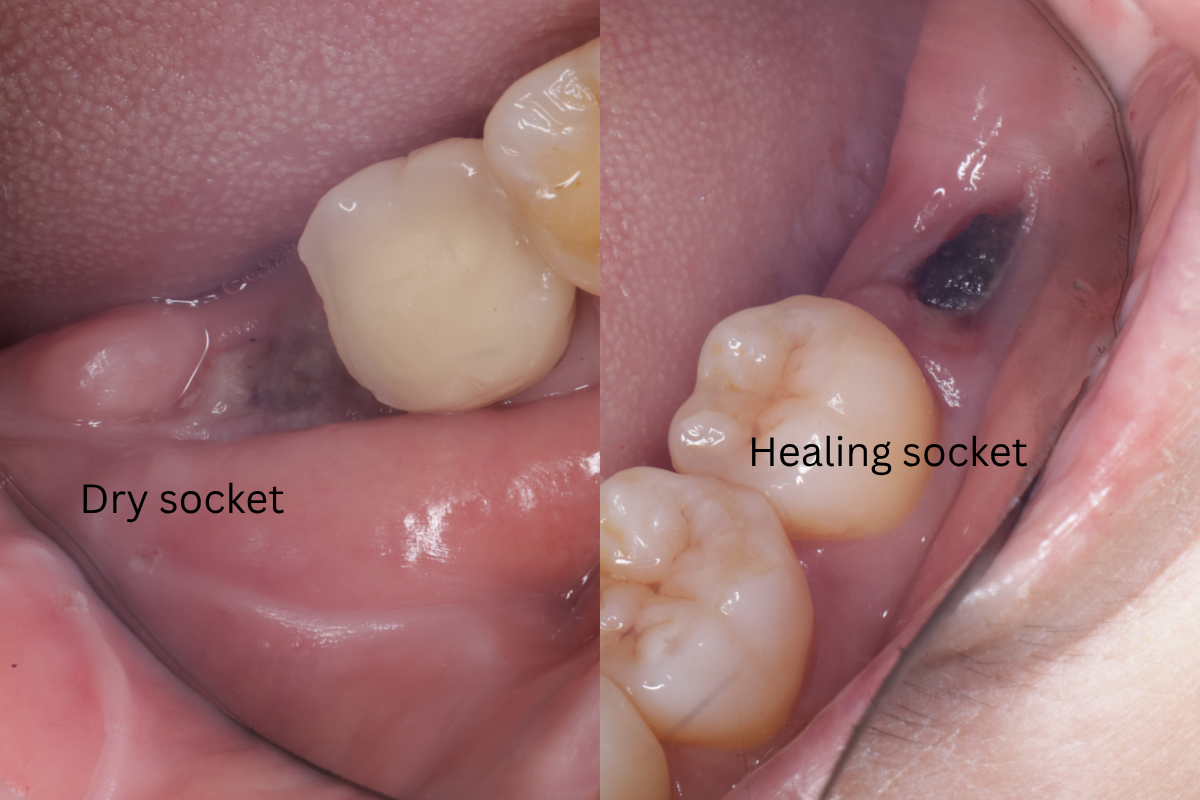
Dry socket, or alveolar osteitis, occurs when that clot dissolves or is dislodged too early. The bone lining the socket is left exposed to air, food and saliva, and bone has no protection of its own. That exposure is what produces the pain, which is why the condition is so disproportionately severe relative to how small the problem is.
It affects roughly 2 to 5 per cent of routine extractions, rising considerably for lower wisdom teeth. It is not dangerous and it does not spread. It is simply extremely uncomfortable until it is treated.
How to recognise it
The timing is the most useful clue. Ordinary post-extraction discomfort is worst on day one and improves steadily. Dry socket does the opposite.
- Pain that starts or sharply worsens on day three to five, after you were already improving.
- A deep, throbbing ache that radiates to the ear, temple, eye or neck on the same side.
- Painkillers barely touch it. This is a hallmark — ordinary extraction pain responds to paracetamol or ibuprofen; dry socket largely does not.
- An empty-looking socket. If you look, you may see whitish bone rather than a dark clot.
- A foul taste and bad breath from the site.
- No fever. Fever, spreading swelling and pus suggest infection instead, which is a different problem.
Steady improvement then sudden worsening is the signature. If day three is markedly worse than day two, that is not normal recovery and it is worth calling us rather than waiting to see whether it settles. It will not settle on its own quickly, and treatment takes minutes.
Why it happens
Anything that creates suction, physical disturbance or impaired blood supply in the first 24 to 48 hours:
- Smoking. By a wide margin the biggest risk factor — both the suction of inhaling and the effect of nicotine on blood flow. Smokers have several times the risk.
- Using a straw. Same suction mechanism.
- Rinsing or spitting vigorously in the first 24 hours.
- Surgical extractions, particularly lower wisdom teeth, where the socket is deeper and blood supply lower.
- Existing infection at the site before the extraction.
- Oral contraceptives, which are associated with a modestly increased risk.
- Poor oral hygiene, or a previous episode of dry socket.
Preventing it
Almost all of the prevention happens in the first 24 hours, and the rules are simple:
- Do not rinse, spit, use a straw or smoke for 24 hours. If you smoke, extending this to 72 hours makes a real difference.
- Bite firmly on the gauze for 30 to 45 minutes to let a solid clot form.
- Eat soft, cool food and chew on the other side.
- Skip strenuous exercise on day one — raised blood pressure can restart bleeding and disturb the clot.
- From day two, rinse gently with warm salt water rather than swishing forcefully.
The full set of instructions is in our wisdom tooth extraction guide.
What treatment involves
This is the reassuring part. Treatment is straightforward and works quickly.
We irrigate the socket to remove food debris, then place a medicated dressing containing a soothing antiseptic material directly into it. Most patients feel substantial relief within an hour, and often within minutes. The dressing is changed every couple of days until the socket is comfortable, usually across three to seven days.
Antibiotics are generally not indicated, because dry socket is not an infection. What it needs is the exposed bone covered.
What not to do
- Do not poke at it with a toothpick or your tongue. Disturbing the exposed bone worsens it.
- Do not pack anything into the socket yourself. Clove oil in particular can burn the surrounding soft tissue when applied undiluted.
- Do not simply take more painkillers and wait. Dry socket does not respond well to them, and it resolves far faster treated.
- Do not assume you need antibiotics. They will not help and are not the treatment.
How long it lasts
Untreated, dry socket typically resolves on its own over seven to ten days as the tissue gradually covers the bone. Treated, the pain is usually controlled the same day and the socket comfortable within three to seven days.
The overall healing timeline is unaffected — the gum still closes over within one to two weeks and the bone fills over the following weeks. Dry socket delays comfort, not healing.
If you think you have it
Call the clinic. We will see you promptly, because it is quick to treat and there is no reason to endure it. We are in Puchong South, near Bandar Puteri, Bandar Kinrara and Puchong Jaya. More about our oral surgery services.
Pain getting worse after an extraction?
Call us. Dry socket takes minutes to treat and there is no need to wait it out.
Frequently asked questions
What is dry socket?
Dry socket, or alveolar osteitis, happens when the blood clot in an extraction socket is lost before healing is complete, leaving bone exposed to air, food and saliva. It is not an infection, but it is very painful.
When does dry socket start?
Typically three to five days after the extraction, after you were already improving. Ordinary post-extraction pain is worst on day one and improves steadily; dry socket does the opposite.
How do I know if I have dry socket?
Deep throbbing pain radiating to the ear or temple, starting or worsening around day three, barely responding to painkillers, often with a foul taste and an empty-looking socket. Fever and spreading swelling suggest infection instead.
How is dry socket treated?
The socket is irrigated to remove debris and a medicated dressing is placed in it. Most patients feel substantial relief within an hour. The dressing is changed every couple of days until the socket is comfortable.
How do I prevent dry socket?
For the first 24 hours do not rinse, spit, use a straw or smoke. Bite firmly on gauze for 30 to 45 minutes after the extraction, eat soft cool food, and avoid strenuous exercise on the first day.
Do I need antibiotics for dry socket?
Generally no. Dry socket is not an infection, so antibiotics do not treat it. What it needs is the exposed bone covered with a medicated dressing.
How long does dry socket last?
Untreated it usually resolves over seven to ten days. Treated, the pain is normally controlled the same day and the socket is comfortable within three to seven days. Overall healing time is not affected.

This article is for general information and does not replace an in-person dental examination. Treatment options and costs depend on your individual condition and can only be confirmed after a clinical assessment.