An impacted wisdom tooth is one that cannot erupt into a normal position. The signs that it needs removing are recurring pain or swelling at the back of the jaw, a bad taste from that area, difficulty opening your mouth, or decay developing on the molar in front of it.
What “impacted” actually means
Impaction is not a disease. It simply means the tooth is blocked — by bone, by gum, or by the tooth in front — and cannot come through into a functional position.
The degree varies enormously, and so does what it implies:
- Soft tissue impaction — the crown has cleared the bone but gum still covers part of it. This is the version that causes most infections.
- Partial bony impaction — part of the tooth is still trapped under bone.
- Full bony impaction — the tooth is completely encased in bone and has never appeared in the mouth.
Counterintuitively, a fully buried tooth often causes fewer problems than a partly erupted one, because there is no opening for bacteria to reach it. The trouble comes from the halfway state.
Which direction it is pointing matters more than the depth
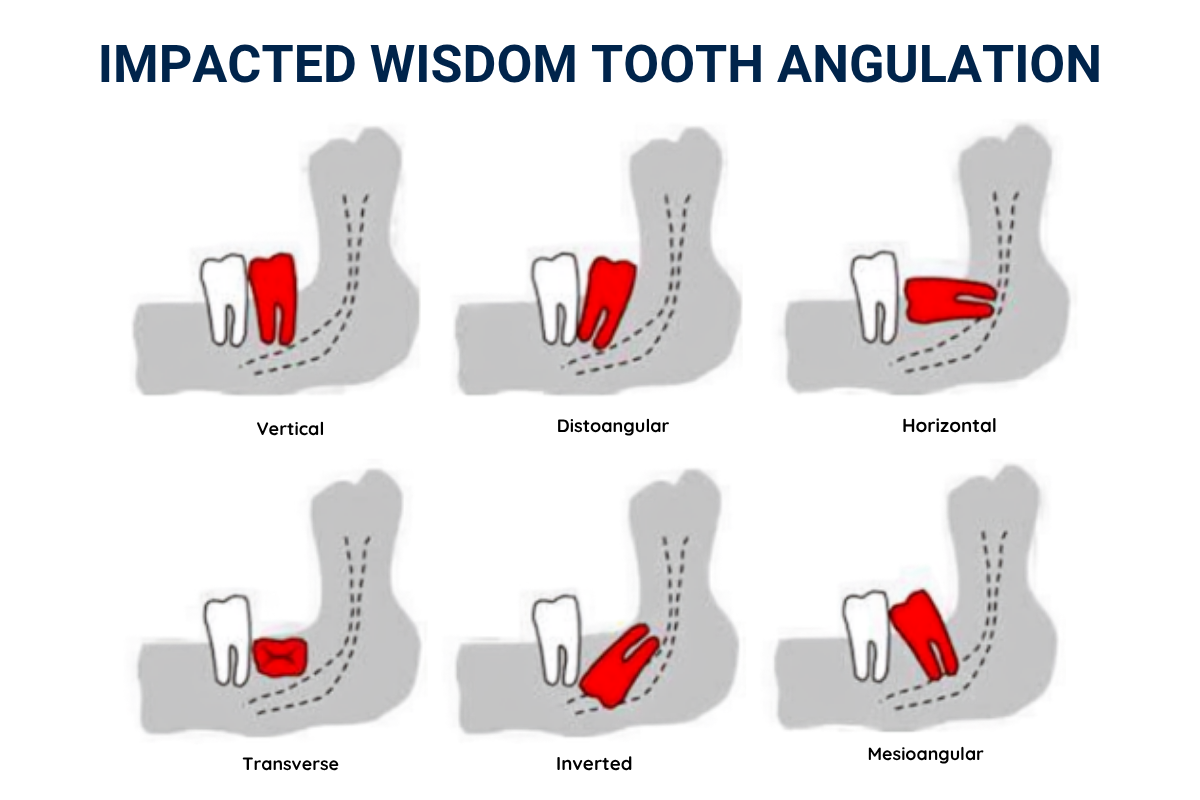
A wisdom tooth can be blocked at almost any angle, and the angle determines what it will do to the teeth around it:
- Mesial — tilted forward against the second molar. The most common by a wide margin, and the one that causes decay on the back surface of the molar in front.
- Vertical — upright but trapped. Often the least troublesome and sometimes worth leaving.
- Distal — tilted backwards, away from the molar. Less common and can be awkward to remove.
- Horizontal — lying on its side, crown pressing directly into the root of the molar in front. Usually needs removing.
The signs it needs attention
Recurring pain and swelling at the back of the jaw
This is the classic presentation: the gum over a partly erupted wisdom tooth becomes inflamed and infected, a condition called pericoronitis. It swells, hurts, and often makes swallowing uncomfortable. It settles with antibiotics and cleaning, then returns weeks or months later because the underlying gum flap is still there.
Two or three episodes is the point at which removal is generally recommended. The infections do not resolve permanently while the flap remains.
A persistent bad taste or smell from one area
Food packing under the gum flap and stagnating there. It is a reliable sign that a pocket exists which you cannot clean.
Difficulty opening your mouth fully
Trismus, from inflammation spreading into the chewing muscles. Combined with fever or difficulty swallowing, this needs to be seen promptly rather than waited out.
Decay on the molar in front
The quiet one. A forward-angled wisdom tooth creates a contact point with the second molar that no toothbrush or floss can reach. Decay develops on the back surface of a healthy molar, is invisible without an X-ray, and is often only found once it is deep. This is the most common reason we recommend removing a wisdom tooth that has never caused any pain.
Pressure, crowding or a cyst
Aching pressure at the back of the jaw is common as the tooth pushes. Less commonly, the sac around an unerupted tooth develops into a cyst that expands and destroys bone — usually painless, and found on a routine X-ray.
On crowding: wisdom teeth are often blamed for front teeth becoming crooked in the twenties. The evidence for this is weak — lower front teeth crowd with age in people who never had wisdom teeth at all. Removing wisdom teeth purely to prevent crowding is not well supported, and we would not recommend it on that basis alone.
How impaction is diagnosed
A panoramic X-ray, which shows all four wisdom teeth, their angulation, root shape, the bone covering them, and how close the lower roots sit to the nerve canal running through the jaw.
Where the roots appear to overlap that canal, a CBCT scan gives a three-dimensional view so the relationship can be seen properly. This changes the surgical plan and is worth doing when indicated.
Does every impacted tooth need removing?
No, and this is worth being clear about. A fully buried, upright wisdom tooth with no symptoms, no decay on the molar in front, no cyst and no gum pocket can reasonably be monitored with periodic X-rays rather than removed.
Removal becomes the right call when there is recurring infection, decay in the tooth or its neighbour, a cyst, damage to the adjacent root, or when the tooth is unrestorable. Age is also a genuine factor: roots are less developed and bone more elastic in the late teens and early twenties, so surgery and healing are both easier then than at forty.
Our guide to wisdom tooth extraction in Puchong covers the procedure, cost and recovery.
Getting it assessed in Puchong
If you have had more than one episode of swelling at the back of your jaw, or you simply want to know what your wisdom teeth are doing, an X-ray and consultation gives you a definite answer. We are in Puchong South, near Bandar Puteri, Bandar Kinrara and Puchong Jaya. More about our oral surgery services.
Pain at the back of your jaw?
Book an assessment in Puchong. X-ray first, and an honest answer on whether it needs to come out.
Frequently asked questions
What does an impacted wisdom tooth mean?
It means the tooth is blocked by bone, gum or the tooth in front and cannot erupt into a normal position. Impaction can be soft tissue, partial bony or full bony, and the angulation matters more than the depth.
What are the signs an impacted wisdom tooth needs removing?
Recurring pain or swelling at the back of the jaw, a persistent bad taste or smell from that area, difficulty opening your mouth fully, decay on the molar in front, or a cyst found on an X-ray.
Does every impacted wisdom tooth need to come out?
No. A fully buried, upright wisdom tooth with no symptoms, no decay on the neighbouring molar and no cyst can reasonably be monitored with periodic X-rays instead of removed.
What is pericoronitis?
Infection of the gum flap over a partly erupted wisdom tooth. It causes swelling, pain and sometimes difficulty swallowing. It settles with antibiotics and cleaning but recurs because the underlying flap remains.
Do wisdom teeth cause crowded front teeth?
The evidence for this is weak. Lower front teeth crowd with age in people who never had wisdom teeth at all. Removing wisdom teeth purely to prevent crowding is not well supported.
Is it better to remove wisdom teeth when young?
Surgery and healing are generally easier in the late teens and early twenties, when roots are less developed and bone is more elastic. That is a genuine consideration, though it does not by itself justify removing a healthy, symptom-free tooth.

This article is for general information and does not replace an in-person dental examination. Treatment options and costs depend on your individual condition and can only be confirmed after a clinical assessment.