Root planing is a deep cleaning of the root surface below the gum line, done under local anaesthesia and usually split across appointments by quadrant. It treats pockets deeper than 4 mm that a routine scale and polish cannot reach, and results are re-measured six to eight weeks afterwards.
How it differs from a normal cleaning
A scale and polish cleans what is above the gum and just below its margin. It assumes gums that are healthy or mildly inflamed, and for most patients that is exactly right.
Root planing addresses a different situation. Once pockets have deepened past 4 mm, calculus is sitting on the root surface several millimetres below the gum, in a space that no toothbrush and no routine cleaning can reach. Removing it requires anaesthesia, specific instruments, and considerably more time per tooth.
The other difference is precision. A scale and polish treats the whole mouth similarly. Root planing is site-specific: we treat the sites the chart identified, at the depths recorded, and leave healthy sites alone. Our guide to scaling versus polishing covers the routine version.
Why the six-point chart decides everything
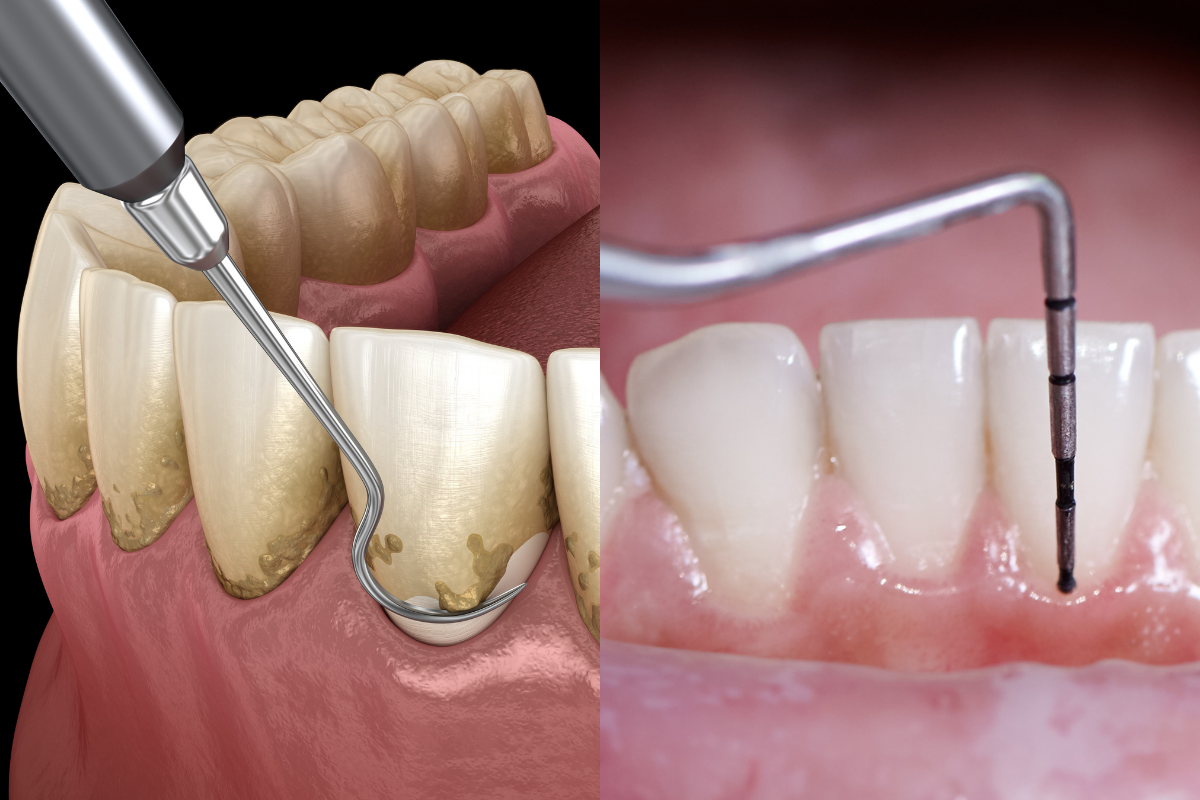
Before any root planing, the depth of the crevice is measured at six points around every tooth — three outer, three inner — with a calibrated probe. On a full dentition that is over 150 readings.
That chart is not paperwork. It is the treatment plan. It tells us which specific sites have pockets, how deep each one is, and therefore how far the instrument needs to reach at each surface. Without it, root planing becomes a general cleaning applied everywhere, which under-treats the deep sites and over-treats the healthy ones.
It also determines how the appointments are divided, and it provides the baseline against which the result will be measured. When we re-chart afterwards, “the pockets on your lower left have gone from 6 mm to 3 mm” is a verifiable outcome. “Your gums look better” is not.
What the appointment is like
Anaesthesia
The quadrant being treated is numbed. This is not optional in any meaningful sense — instrumenting a root surface several millimetres below the gum on an inflamed site is uncomfortable without it, and discomfort makes thorough work impossible.
The cleaning
Ultrasonic instruments remove the bulk of subgingival deposits, and hand instruments finish the root surface where tactile feedback matters. The aim is a root surface clean and smooth enough that the gum tissue can reattach against it and the pocket can shrink.
You will feel vibration, water and pressure, but not pain. It is methodical work — several minutes per tooth surface rather than a quick pass.
How long, and how many visits
Root planing is normally done one or two quadrants at a time, in appointments of 45 to 90 minutes. Doing the whole mouth in a single session is possible but leaves you numb throughout and sore everywhere afterwards, with no comfortable side to chew on.
How many sessions you need is decided entirely by the chart. Localised disease around a few teeth may take one visit. Generalised pocketing usually means four.
Why it is split by quadrant: comfort is part of it, but the bigger reason is thoroughness. Root planing done properly is slow, and a session covering the entire mouth invariably means less time per surface. Splitting it is what allows each site to be treated to the depth the chart recorded.
Afterwards: what to expect
- Numbness for two to four hours. Avoid chewing until it wears off.
- Tenderness in the treated area for a few days. Ordinary painkillers are usually enough.
- Sensitivity to cold, often marked for a week or two. Exposed root surface has no enamel, and it has just been cleaned. Desensitising toothpaste helps and it settles.
- Some bleeding when brushing the area for a few days.
- Gums that shrink back as swelling resolves. Teeth may look longer and gaps more visible. This is the treatment working, though it does not feel that way.
Warm salt water rinses from the day after help. Keep brushing the treated area gently — avoiding it is the most common mistake and it undoes the work.
The re-evaluation is not optional
Six to eight weeks after treatment, we re-chart the same six points on the same teeth. That interval exists because the tissue needs time to heal and tighten before measurement means anything.
Three outcomes are possible:
- Pockets reduced to 3 mm or less. The site has responded. It moves to maintenance.
- Pockets improved but still 4 mm. Often monitored, sometimes re-instrumented.
- Pockets still 5 mm or more. Non-surgical treatment has not been enough at that site, and surgical access may be needed to clean the root under direct vision.
Skipping the re-evaluation means never knowing which of the three you got. It is the step that turns treatment into a measurable result.
What root planing can and cannot do
It removes the deposits driving the disease, allows inflammation to resolve, and lets tissue tighten so pockets become shallower and cleanable. It stops the destruction.
It does not rebuild bone that has already been lost, and it does not bring receded gum back up. Pocket reduction comes from inflammation resolving and tissue tightening, not from regeneration. Our guide to gum disease stages sets out what each stage can realistically expect.
Maintenance is where the outcome is decided
This is the part that matters most and gets the least attention. After root planing, the standard recall interval is three months, not six.
The reason is bacterial: pathogenic species recolonise treated pockets over roughly twelve weeks. Maintenance appointments interrupt that cycle before pockets re-establish. Patients who complete a course of root planing and then stop attending reliably relapse, often back to where they started within two years.
Put plainly, the root planing is what stops the disease and the maintenance is what keeps it stopped. Budgeting for one without the other does not work, which our guide to what affects gum treatment costs covers in more detail.
Root planing in Puchong
Treatment starts with a full periodontal assessment so we know which sites need what. We are in Puchong South, near Bandar Puteri, Bandar Kinrara and Puchong Jaya. More about our gum treatment services.
Been told you need a deep cleaning?
Book a periodontal assessment in Puchong. Six-point charting first, then a plan you can see the reasoning behind.
Frequently asked questions
What is root planing?
A deep cleaning of the root surface below the gum line, done under local anaesthesia. It treats pockets deeper than 4mm where calculus sits several millimetres below the gum, out of reach of a routine scale and polish.
How is root planing different from a normal cleaning?
A scale and polish cleans above the gum and just below its margin, and treats the whole mouth similarly. Root planing reaches several millimetres below the gum at specific sites identified by charting, and requires anaesthesia.
Does root planing hurt?
The quadrant is numbed first, so you feel vibration, water and pressure rather than pain. Tenderness for a few days afterwards is normal and ordinary painkillers are usually enough.
How many appointments does root planing take?
Usually one or two quadrants per appointment, in sessions of 45 to 90 minutes. Localised disease may take one visit; generalised pocketing usually means four. The charting decides.
Why are my teeth sensitive after root planing?
Exposed root surface has no enamel and has just been cleaned, so cold reaches the nerve more directly. Sensitivity is often marked for a week or two, helped by desensitising toothpaste, and settles.
Why do I need to come back six weeks later?
To re-chart the same six points on the same teeth. Tissue needs that time to heal and tighten before measurement means anything. The re-chart shows whether pockets reduced, which is the only objective measure of whether treatment worked.
How often do I need cleanings after root planing?
Every three months rather than six. Pathogenic bacteria recolonise treated pockets over roughly twelve weeks, and patients who stop attending reliably relapse, often back to baseline within two years.

This article is for general information and does not replace an in-person dental examination. Treatment options and costs depend on your individual condition and can only be confirmed after a clinical assessment.