Gum treatment is not a single procedure with a single price. The cost depends on how far the disease has progressed, how many sites need treating, how many sessions that takes, and what ongoing maintenance is required. It is quoted after a full periodontal assessment, not before.
Key takeaways
- Gum treatment is priced by what your mouth actually needs, which is why nobody can quote it over the phone.
- The assessment comes first: six pocket measurements around every tooth, plus X-rays.
- Mild cases may need one cleaning. Established periodontitis is a course of treatment over weeks.
- Maintenance every three months is part of the cost, not an optional extra.
- Treating gum disease is consistently cheaper than replacing the teeth it takes.
Why there is no single price
Ask what a filling costs and there is a sensible answer, because a filling is a defined procedure on one tooth. Gum disease is not like that. Two people can both be told they have periodontitis and need completely different amounts of work.
One might have four pockets of 5 mm confined to the back molars, resolved in a single session. Another might have generalised pocketing of 6 to 8 mm across the whole mouth, requiring treatment quadrant by quadrant, re-assessment, some surgical access, and three-monthly maintenance indefinitely.
Those are the same diagnosis and vastly different treatments. Quoting a figure before knowing which one you are would be guessing.
The assessment always comes first
Before anything is priced, we need to know exactly what is happening, and that requires measurement rather than inspection.
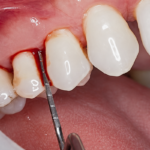
We chart six points around every tooth — three on the outer surface, three on the inner — with a calibrated periodontal probe. On a full dentition that is over 150 measurements. We record which sites bleed on probing, note recession and mobility, and take X-rays to see the bone level directly.
This matters for cost as much as for diagnosis. Gum disease is rarely uniform: a mouth might have twelve problem sites and a hundred healthy ones. Charting identifies exactly which sites need treatment, so the treatment plan is specific rather than a blanket approach applied everywhere. You pay for the sites that need work.
It also creates the baseline. When we re-chart after treatment, the numbers show objectively whether pockets have reduced. Without them, you have no way of knowing whether what you paid for worked.
Worth asking anywhere you are quoted for gum treatment: has a full six-point chart been done, and can you see the numbers? A quote given without charting is a quote for an unknown quantity of work, and it is the reason “gum treatment” quotes vary so widely between clinics for what sounds like the same thing.
What the treatment actually consists of
Gingivitis: cleaning and technique
Where inflammation is confined to the gum and pockets remain 1 to 3 mm, a thorough scale and polish removes the calculus driving it, combined with specific advice on the surfaces you are missing. Usually one appointment, and the condition resolves completely. This is by a wide margin the cheapest point at which to deal with gum disease. Our guide to scaling and polishing covers what that appointment involves.
Periodontitis: root planing
Once pockets exceed 4 mm, calculus sits on the root surface below the gum where a routine cleaning cannot reach it properly. Root planing cleans that root surface methodically, usually under local anaesthesia, and is normally done quadrant by quadrant across separate appointments.
How many quadrants need treating, and how many sessions each takes, is the largest single variable in the cost. This is decided by the chart.
Re-evaluation
Six to eight weeks after root planing, we re-chart. Pockets that have reduced to 3 mm or less have responded and move to maintenance. Sites still measuring 5 mm or more have not, and need something further.
Surgical access, where needed
Deep pockets that do not respond to root planing may require the gum to be reflected so the root can be cleaned under direct vision, and in selected cases regenerative procedures. Only a minority of patients need this, and it is only proposed once non-surgical treatment has been given a fair chance.
Maintenance, ongoing
This is the part patients most often fail to budget for, and the part that determines whether the rest holds. After periodontitis, three-monthly maintenance is the standard interval. Bacteria recolonise treated pockets in roughly that timeframe, and disease recurs reliably in people who stop attending.
What drives the cost, in order of impact
- How advanced the disease is. Gingivitis and advanced periodontitis are separated by an order of magnitude in treatment required.
- How many sites and quadrants need treating. Localised disease around a few teeth is a fraction of the work of generalised disease.
- How many sessions. Root planing is typically split across appointments for comfort and thoroughness.
- Whether the assessment is charged separately. Charting and X-rays are part of the process and may be itemised.
- Whether surgery is needed. A minority of cases, but it changes the figure.
- Maintenance frequency, which is an ongoing cost rather than a one-off.
- Work that gum treatment reveals. Once inflamed tissue shrinks back, root surface decay and failing restoration margins sometimes become visible for the first time.
How we handle quoting it
The assessment is booked first. You leave that appointment with your actual pocket depths, X-rays, a diagnosis with a stage attached, and a written plan that sets out what needs treating, in how many sessions, and what it costs. Nothing is started before you have that.
Where the plan is long, it is sequenced so the most compromised sites are treated first, and it can be spread over time. If you would like an indication of fees before booking, call the clinic and we will tell you what an assessment costs and the range a course of treatment typically falls into.
Questions worth asking before you agree to anything
Gum treatment quotes vary more between clinics than almost any other dental treatment, and the reason is usually that they are quoting for different amounts of work. These four questions make the comparison meaningful:
- “Have my pocket depths been charted at six points on every tooth, and can I see the numbers?” If the answer is no, the quote is for an unspecified quantity of work.
- “Which specific sites are being treated, and how deep are they?” A plan should name quadrants and sites, not just say “gum treatment”.
- “How many sessions, and what happens between them?” Root planing split across appointments is normal; you should know how many before starting.
- “When will you re-measure, and what result are we aiming for?” Re-charting at six to eight weeks is the step that proves the treatment worked. A plan without it has no defined endpoint.
A clinic that answers all four clearly is quoting for a defined piece of work. One that cannot is quoting for an impression.
The comparison that actually matters
Gum treatment can feel expensive for something with no visible result — you do not walk out with a new crown to look at. The relevant comparison is not with doing nothing, though, because doing nothing has its own price.
Untreated periodontitis takes teeth. Replacing one lost tooth with a bridge starts from RM3,600 and with an implant from RM6,000, and implants are considerably harder to place in a jaw that has lost bone to periodontal disease — bone grafting often becomes necessary. Losing several teeth compounds that quickly.
Against those numbers, a course of gum treatment and ongoing three-monthly maintenance is consistently the cheaper path. It is also the only one that keeps your own teeth.
Getting assessed in Puchong
If you have been told you have gum disease, or your gums bleed persistently, start with an assessment and real numbers. We are in Puchong South, close to Bandar Puteri, Bandar Kinrara and Puchong Jaya. More about our gum treatment services, or read our guide to gum disease stages and signs.
Want to know what your gums actually need?
Book a periodontal assessment in Puchong. Full six-point charting, X-rays, and a written plan with costs before anything starts.
Frequently asked questions
How much does gum treatment cost in Puchong?
It depends on how far the disease has progressed, how many sites and quadrants need treating, and how many sessions that takes. A full periodontal assessment with six-point charting and X-rays comes first, and the plan is quoted from that.
Why can’t a clinic quote gum treatment over the phone?
Because two people with the same diagnosis can need vastly different amounts of work. One may have four shallow pockets treated in a single session; another may need every quadrant treated, re-assessment and surgical access.
What is included in a periodontal assessment?
Six pocket measurements around every tooth with a calibrated probe, a record of which sites bleed on probing, notes on recession and mobility, and X-rays showing the bone level. That is over 150 measurements on a full dentition.
Is maintenance included in the cost of gum treatment?
No, and it is the part patients most often fail to budget for. After periodontitis, three-monthly maintenance is the standard interval and is an ongoing cost. Disease recurs reliably in people who stop attending.
Is gum treatment worth the cost?
Untreated periodontitis takes teeth. Replacing one lost tooth starts from RM3,600 for a bridge or RM6,000 for an implant, and implants are harder to place in a jaw that has lost bone. Treatment is consistently the cheaper path.
How many appointments does gum treatment take?
Gingivitis often needs one. Root planing for periodontitis is usually done quadrant by quadrant across separate appointments, followed by re-charting six to eight weeks later. The number is decided by the charting.

This article is for general information and does not replace an in-person dental examination. Treatment options and costs depend on your individual condition and can only be confirmed after a clinical assessment.