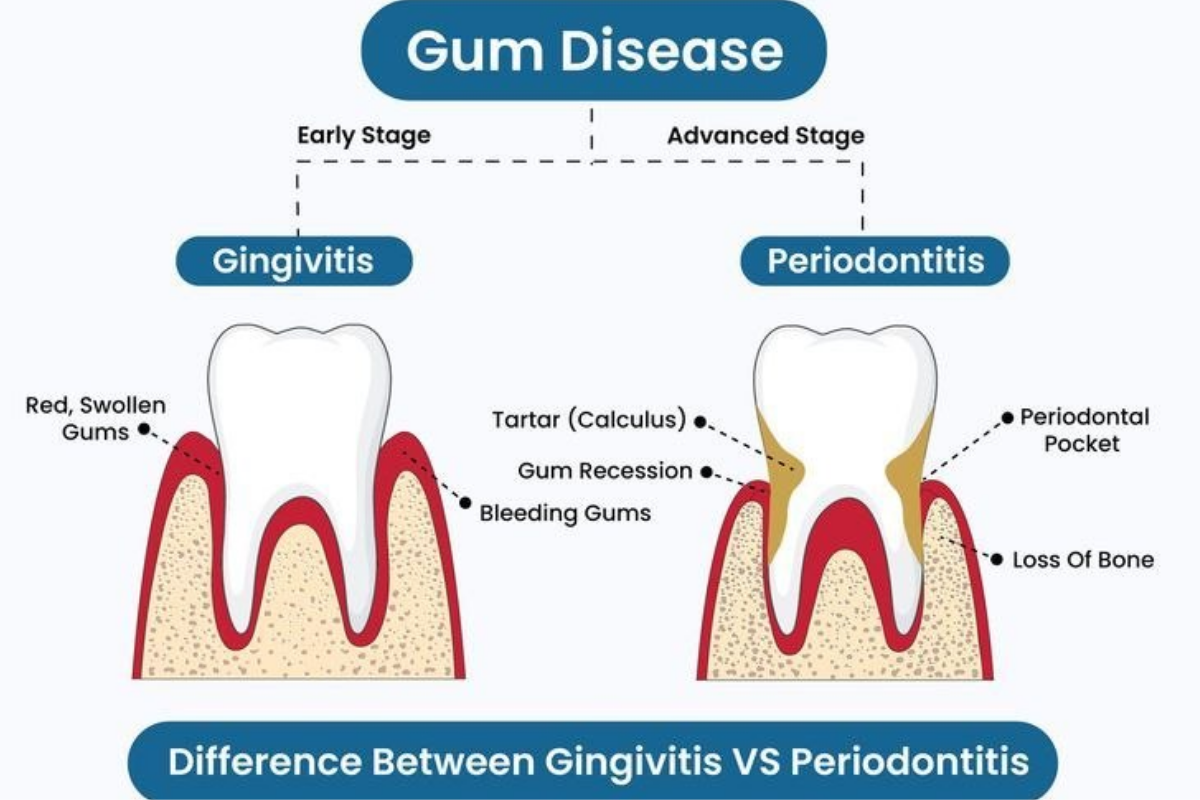
Gingivitis is inflammation of the gum only, and it is completely reversible. Periodontitis means the inflammation has destroyed attachment and bone, which does not grow back. The line between them is a pocket depth of 4 mm — below it, gingivitis; above it, periodontitis.
Why the distinction is not academic
These two conditions look similar in the mirror. Both produce red, swollen gums that bleed when brushed. Both cause bad breath. A patient with either would describe their symptoms in almost identical terms.
But one of them resolves completely with a cleaning and better technique, leaving no trace. The other has already caused permanent damage, requires a course of treatment, and commits you to lifelong maintenance to stop it advancing.
You cannot tell which you have by looking. That is the entire reason gum disease is diagnosed by measurement.
| Gingivitis | Periodontitis | |
|---|---|---|
| What is affected | Gum tissue only | Gum, attachment fibres and bone |
| Pocket depth | 1–3 mm | 4 mm and above |
| Bone loss on X-ray | None | Present |
| Reversible | Yes, completely | No — but it can be stopped |
| Teeth loosening | Never | Possible as it advances |
| Treatment | Scale, polish, better technique | Root planing, sometimes surgery, lifelong maintenance |
| Ongoing care | Normal recall interval | Every 3 months |
Gingivitis: inflammation without loss
Plaque accumulates at the gum line and the immune system responds. Blood flow increases, tissue swells, and vessels sit close enough to the surface that a toothbrush breaks them. That is the whole of gingivitis.
Crucially, the fibres attaching the gum to the tooth are intact, and the bone is untouched. The crevice around the tooth still measures 1 to 3 mm — it may look deeper because the swollen gum sits higher, but nothing has been lost underneath.
Remove the plaque and calculus, clean properly at home, and the tissue returns to normal within one to two weeks. Complete resolution, no lasting consequence. It is one of the few genuinely reversible conditions in dentistry.
Periodontitis: the line has been crossed
In susceptible people, and particularly where inflammation goes untreated for long enough, the process extends beyond the gum. The fibres anchoring the gum to the root are destroyed, and the bone begins to resorb.
Two things follow. The gum detaches downwards, creating a genuine pocket that is deeper than 3 mm. And because that pocket cannot be cleaned by any toothbrush, calculus forms inside it, driving more inflammation, deepening it further. The cycle becomes self-sustaining.
Neither the lost attachment nor the lost bone regenerates. Treatment can stop the process, and pockets often shrink as inflammation resolves and tissue tightens, but the supporting structure that was destroyed is gone.
Not everyone with gingivitis develops periodontitis
This is worth stating, because it is often presented as an inevitable progression. It is not.
Most people have some gingivitis at some point, and the majority never develop periodontitis. Susceptibility varies substantially, largely for genetic reasons: two people with identical plaque levels can have completely different outcomes over twenty years.
What raises the risk is smoking, poorly controlled diabetes, a family history of early tooth loss, and prolonged untreated inflammation. What it is not is a simple matter of how hard you brush.
How the two are actually distinguished
By probing, and only by probing. A calibrated periodontal probe is walked gently around each tooth and the depth of the crevice measured at six points — three on the outer surface, three on the inner. On a full dentition that is over 150 individual readings.
Six points rather than one because disease is site-specific. A tooth can measure a healthy 2 mm on its cheek side and 6 mm between it and its neighbour. Spot-checking, or assessing by appearance, misses exactly the sites where periodontitis hides.
Alongside the depths we record bleeding on probing, recession, and mobility. X-rays then show the bone level directly, which is the definitive confirmation: gingivitis shows normal bone, periodontitis shows loss.
One measurement can mislead on its own. A 5 mm reading might be a true pocket with bone loss, or a swollen gum sitting higher over a healthy attachment — sometimes called a false pocket. The X-ray is what separates them, which is why the diagnosis needs both.
What treatment looks like for each
Gingivitis
A thorough scale and polish, plus specific advice about the surfaces you are missing. Gums settle within one to two weeks. You then return to your normal recall interval. Our guide to scaling and polishing covers the appointment.
Periodontitis
Root planing to clean the root surface below the gum, usually under local anaesthesia and typically quadrant by quadrant. Re-charting six to eight weeks later shows whether pockets have reduced. Sites that have not responded may need surgical access. Then three-monthly maintenance, permanently.
Our guide to gum disease stages and treatment sets out the full picture, and why gums bleed covers the symptom that brings most people in.
What to expect after treatment for periodontitis
Being straightforward about this saves disappointment. As inflammation resolves, swollen gum tissue shrinks back to healthy dimensions. That is a sign of success, but it has visible consequences:
- Teeth look longer, because gum that was puffed up has settled to where the attachment actually is.
- Spaces between teeth become more noticeable.
- Sensitivity increases for a while, as exposed root surface has no enamel.
None of these mean the treatment went wrong. They mean the swelling that was concealing the underlying situation has gone. They are also the strongest argument there is for catching gum disease while it is still gingivitis.
Finding out which you have, in Puchong
If nobody has ever measured your pocket depths, you do not yet know which of the two you have. An assessment takes one appointment and gives you numbers. We are in Puchong South, near Bandar Puteri, Bandar Kinrara and Puchong Jaya. More about our gum treatment services.
Gingivitis or periodontitis?
Book a periodontal assessment in Puchong. Six-point charting and X-rays give a definite answer, not an impression.
Frequently asked questions
What is the difference between gingivitis and periodontitis?
Gingivitis is inflammation of the gum tissue only, with no attachment or bone lost, and it is completely reversible. Periodontitis means attachment fibres and bone have been destroyed, which does not regenerate.
How do you tell which one you have?
By measuring pocket depth at six points around every tooth with a calibrated probe, and by X-rays showing the bone level. Gingivitis measures 1 to 3mm with normal bone; periodontitis measures 4mm or more with visible bone loss.
Can periodontitis be reversed?
No. Lost attachment and bone do not regenerate. Treatment stops the process and pockets often shrink as inflammation resolves, but the supporting structure that was destroyed is gone.
Does gingivitis always turn into periodontitis?
No. Most people experience gingivitis at some point and the majority never develop periodontitis. Susceptibility varies substantially, largely for genetic reasons, and is increased by smoking and poorly controlled diabetes.
How long does gingivitis take to clear up?
Usually one to two weeks after the calculus is removed and home cleaning improves. It resolves completely with no lasting consequence, which is what makes catching gum disease at this stage so valuable.
Why do my teeth look longer after gum treatment?
Because swollen gum tissue has shrunk back to healthy dimensions, revealing where the attachment actually is. It is a sign the inflammation has resolved rather than a sign something went wrong.

This article is for general information and does not replace an in-person dental examination. Treatment options and costs depend on your individual condition and can only be confirmed after a clinical assessment.